

The carousel covered one famous finding: the deep core switches on before you move, and in back pain that timing changes. This article tells the full story, including what later research added, what it changed, and what that means for how we train.
—————————————————
1 · Your body prepares before it moves
Lift your arm quickly in front of you. Before the shoulder muscles even start, muscles in your trunk and legs have already switched on to stop you tipping forward. You never decided to do that. Your nervous system predicted the disturbance and acted first.
This is called an anticipatory postural adjustment. It was first described by Russian researchers in the 1960s, who noticed that leg and trunk muscles fired before a quick arm raise (Belenkii et al., 1967).
A feedback response reacts after something happens. A feedforward response prepares before it happens. Much of your stability is feedforward.
2 · The famous studies
In the 1990s, Paul Hodges and Carolyn Richardson looked at this in the deep abdominal muscles. Using fine-wire electrodes, they measured when each muscle switched on during quick arm and leg movements.

The transversus abdominis, the deepest abdominal layer, consistently fired before the limb started moving: roughly 30 milliseconds ahead of an arm movement, and earlier still for leg movements. It did so whichever direction the limb moved (Hodges & Richardson, 1997a; 1997b). That pointed to a general preparation of the trunk, not a reaction to one specific force.
3 · What changed in people with back pain
When they repeated the tests in people with chronic low back pain, the transversus abdominis switched on late, after the limb had started moving instead of before (Hodges & Richardson, 1996; 1998).
Later work showed that some of these changes can persist even when people are free of pain between episodes (MacDonald et al., 2009). The nervous system had learned a different way of organising the trunk, and kept it.
4 · What later research added: it’s not one muscle
This is where the popular story usually stops, and where it gets more interesting.
Over the following years, it became clear that people in pain don’t all do the same thing. Some show a delay in deep muscles. Many others increase activity in the bigger, more superficial muscles and stiffen the whole trunk. Hodges later described this as an adaptation to pain: the body protects itself by moving more rigidly (Hodges & Tucker, 2011).

That protection makes sense in the short term. Over the long term, a trunk that only knows how to stiffen moves less, loads the spine in fewer ways and may keep the system on alert.
The problem isn’t a “weak core”. It’s a nervous system that has narrowed its options.
5 · Can timing be retrained? Yes
Encouragingly, timing responds to practice. In people with recurrent back pain, a single session of specific motor training brought the deep muscles’ timing forward during unrelated arm movements (Tsao & Hodges, 2007). With a few weeks of training, those improvements were still there months later (Tsao & Hodges, 2008).
So the timing is trainable. It isn’t fixed, and it isn’t a matter of strength alone.
6 · Does that mean motor control training is best for back pain?
Here we need to be honest, and correct something we used to say. A Cochrane review compared “motor control exercise” with other forms of exercise for chronic low back pain. It helped, but no more than other types of exercise did (Saragiotto et al., 2016). A Cochrane review of Pilates for back pain found something similar: better than minimal treatment, but not clearly better than other exercise (Yamato et al., 2015).
What this tells us: changing muscle timing is real and possible, but for pain, what seems to matter most is moving regularly, progressively and with confidence. The type of exercise matters less than doing it, enjoying it and building up gradually.
That’s not a reason to dismiss timing. It’s a reason to train it as part of whole, varied movement, rather than as a separate “switch on your core” exercise.
7 · What this means in class
We don’t brace all the time. Constant bracing is the rigid strategy the body already uses in pain. A healthy trunk switches on as needed, then lets go.
We train anticipation in many situations. Arm and leg movements in different directions and at different speeds, so the system learns to prepare for each one.
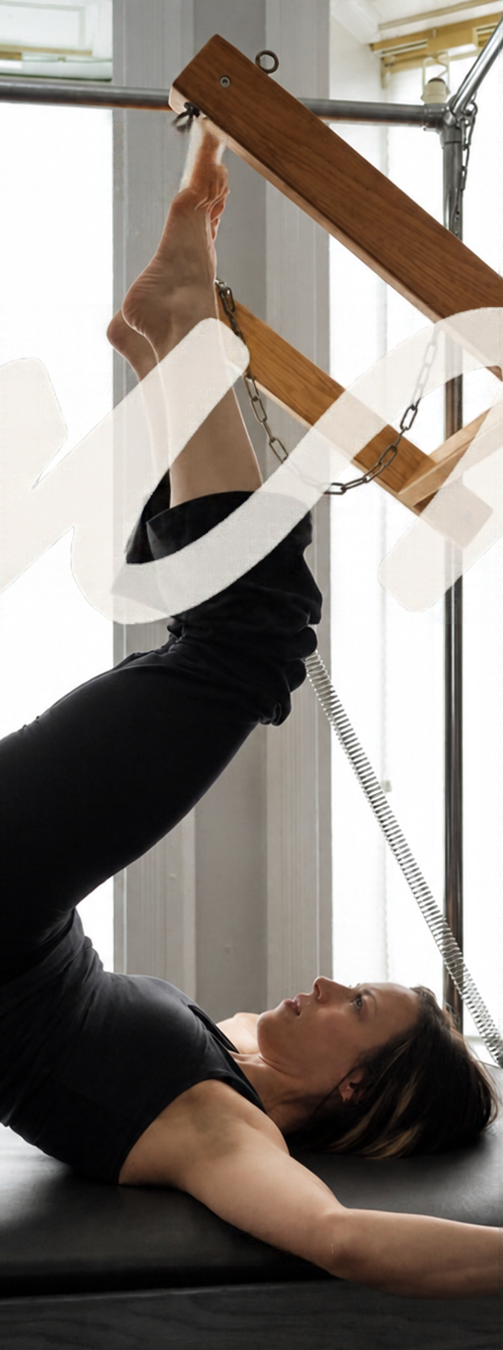
We use the moving carriage. The reformer shifts under you. Your trunk has to predict and respond, which is exactly the skill we’re after.
We pair it with breathing. Your diaphragm helps stabilise the trunk and breathe at the same time. Holding your breath to feel “stable” is a sign the system is choosing stiffness.
We progress. From slow and predictable to faster and less predictable, with real load.
We use the whole studio. Each apparatus challenges the trunk to prepare in a different way:
Mat: single leg stretch and the hundred, with steady breathing while the limbs move.
Reformer: kneeling and standing work on the moving carriage.
Wunda Chair: standing single-leg pumps, where the trunk has to stay quiet as the pedal moves.
Cadillac: standing arm springs and the roll-down bar, with the pull coming from different directions.
Spine Corrector: leg circles lying over the arc, with the trunk supported but the limbs free.
Ladder Barrel: short box rotations, with the legs anchored and the trunk working against gravity.
8 · Try this: the reaching test
Lie on your back, knees bent, feet on the floor. Breathe normally. Lift one arm towards the ceiling and lower it, then the other, getting slowly faster. Notice: does your breath stop? Does your whole trunk grip, or just get quietly firmer as the arm moves? Then try lifting one foot a few centimetres instead.
Subscribe to the newsletter
-
Subscribe to the newsletter -
The goal isn’t to feel nothing. It’s a calm, steady trunk that prepares without locking.
References1. Belenkii VE, Gurfinkel VS, Paltsev YI. Elements of control of voluntary movements. Biofizika. 1967;12(1):135–141.2. Hodges PW, Richardson CA. Feedforward contraction of transversus abdominis is not influenced by the direction of arm movement. Exp Brain Res. 1997;114(2):362–370.3. Hodges PW, Richardson CA. Contraction of the abdominal muscles associated with movement of the lower limb. Phys Ther. 1997;77(2):132–142.4. Hodges PW, Richardson CA. Inefficient muscular stabilization of the lumbar spine associated with low back pain. Spine. 1996;21(22):2640–2650.5. Hodges PW, Richardson CA. Delayed postural contraction of transversus abdominis in low back pain associated with movement of the lower limb. J Spinal Disord. 1998;11(1):46–56.6. MacDonald D, Moseley GL, Hodges PW. Why do some patients keep hurting their back? Evidence of ongoing back muscle dysfunction during remission from recurrent back pain. Pain. 2009;142(3):183–188.7. Hodges PW, Tucker K. Moving differently in pain: a new theory to explain the adaptation to pain. Pain. 2011;152(3 Suppl):S90–S98.8. Tsao H, Hodges PW. Immediate changes in feedforward postural adjustments following voluntary motor training. Exp Brain Res. 2007;181(4):537–546.9. Tsao H, Hodges PW. Persistence of improvements in postural strategies following motor control training in people with recurrent low back pain. J Electromyogr Kinesiol. 2008;18(4):559–567.10. Saragiotto BT et al. Motor control exercise for chronic non-specific low-back pain. Cochrane Database Syst Rev. 2016;(1):CD012004.11. Yamato TP et al. Pilates for low back pain. Cochrane Database Syst Rev. 2015;(7):CD010265.