
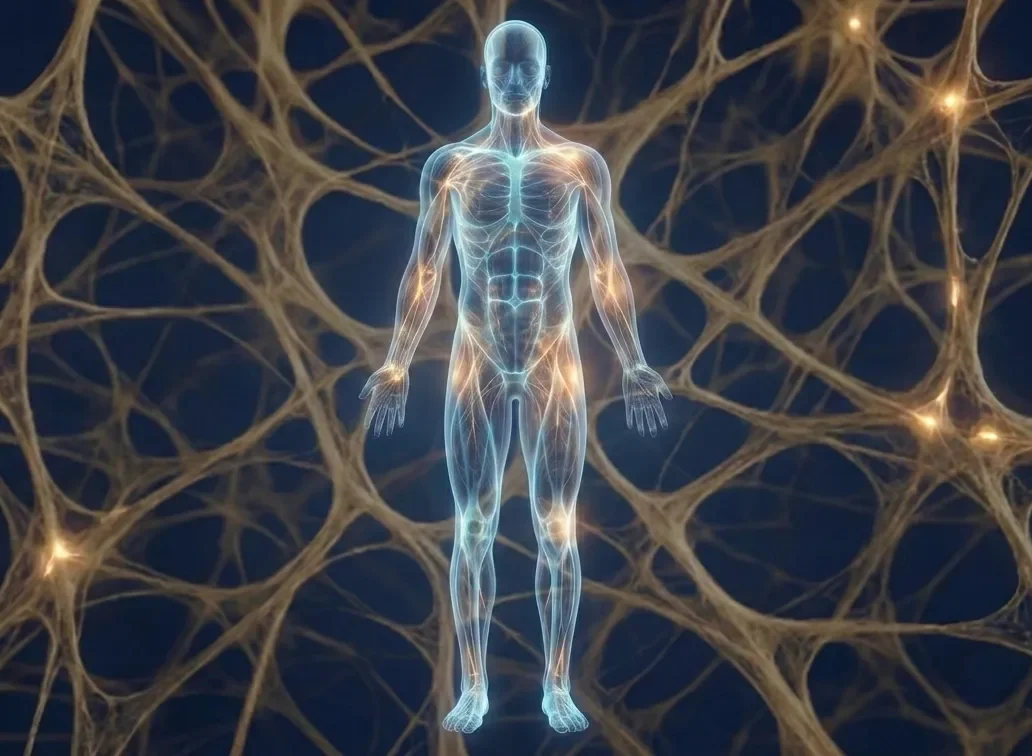
In Chapter 4 we looked at nerves that need to slide through fascia. This chapter turns it around: fascia itself is full of nerves. Once you see it as a sensory organ rather than packaging, a lot of things make more sense, from why slow, attentive movement feels different to why some back pain doesn’t come from the discs or muscles at all.

1 · More than wrapping
For a long time, anatomists cut fascia away to get to the “important” structures underneath. Studies of its nerve supply changed that picture.
Deep fascia contains several types of sensory receptors:
Free nerve endings, the most numerous. Many of them signal potential threat (nociceptors); others respond to pressure, stretch or temperature.
Ruffini endings, which respond to slow, sustained stretch and sideways shear.
Pacini corpuscles, which respond to fast changes: vibration and quick pressure.
Golgi-type receptors near muscle-tendon junctions, which sense tension.
In other words, your connective tissue is constantly reporting on pressure, stretch, speed and threat.
2 · Fascia and body awareness
Proprioception, your sense of where your body is and how it’s moving, is often attributed to muscle spindles and joint receptors. The receptors in fascia contribute too, especially to sensing stretch and shear between layers. This is one reason why the quality of movement matters: slow, varied, attentive movement gives this system rich and clear information; repetitive, hurried movement gives it very little.
3 · Fascia and back pain
The thoracolumbar fascia, the large sheet across your lower back, is densely supplied with nerve endings, including nociceptors and sympathetic fibres. When researchers injected a small amount of hypertonic saline (a standard way of provoking short-lived pain) into this fascia in healthy volunteers, the pain was more intense, lasted longer and spread further than when the same injection went into the muscle beneath it.
Ultrasound studies also show that in people with chronic low back pain, the layers of the thoracolumbar fascia slide about 20% less over each other than in people without pain. We don’t know yet whether that’s a cause or a consequence of pain and moving less. But together, these findings suggest that fascia can be part of the back pain story, not only discs and muscles.
Fascia isn’t only a structure that moves. It’s a structure that feels.
4 · What this means for touch

Manual therapists often describe “releasing” fascia. The forces needed to permanently deform dense fascia are much larger than what a pair of hands can apply, so it’s unlikely that touch reshapes the tissue mechanically. What touch clearly does is talk to the nervous system: it changes how the area is sensed, how protective the muscles around it are and how much it hurts. That doesn’t make it less valuable. It explains why skilled touch and attentive movement often work well together: they speak to the same nerves.
5 · What this means for movement
If fascia is a sensory organ, the way you move becomes the information you give it. In practice that means:
Variety: different directions, angles and speeds give different receptors something to report.
Slowness sometimes: slow, sustained movement emphasises stretch and shear, the language of Ruffini endings.
Attention: noticing what you feel sharpens the signal. Closing your eyes in a safe position takes vision away and makes your body sense the rest.
Not too much threat: forcing a stretch through pain makes the nervous system more protective, not less.
6 · Two exercises to try
1 · Spine stretch forward with a slow head nod
Targets: The sliding of the nervous system and the fascia along the back of the body, from the head to the feet
Why: It connects Chapter 4 and this one: the nerves glide, and the fascia around them sends rich information about stretch. Done slowly, it’s also a lesson in noticing.
Set-up: Sit tall on the floor with legs straight and a little wider than hips, feet flexed. If your back rounds, sit on a cushion or bend the knees slightly.
Movement: Exhale and nod the chin slightly, then roll forward one vertebra at a time, reaching your arms forward. Pause. Inhale and lift your head first (“look up”), then roll back up. On the next one, keep the head neutral the whole time and notice the difference.
Cues: “Peel the spine off an imaginary wall behind you.” “Make the movement smaller, not bigger, if you feel pulling or tingling.”
Watch for: Collapsing from the hips instead of articulating the spine; pushing into tingling or pins and needles. Nerve symptoms should ease straight away when you come back; if not, keep the range smaller.
Reps: 5–6 slow repetitions.
2 · Hands-on roll-down
Targets: Shear between the layers of the thoracolumbar fascia, and your awareness of the lower back
Why: The fascia in people with chronic back pain slides less. This is a gentle way to move and feel that area at the same time.
Set-up: Stand with feet hip-width apart, knees soft. Place the backs of your hands on your lower back, on either side of the spine.
Movement: Exhale and slowly roll down, head first, as far as is comfortable. Feel the skin and tissue under your hands spread and slide. Inhale at the bottom. Exhale and roll up from the pelvis.
Cues: “Let the lower back get wider under your hands.” “Go only as far as you can still feel your hands clearly.”
Watch for: Locking the knees, holding your breath, going into pain.
Reps: 4–5 slow repetitions. A good one to start the day with, later in the morning rather than straight out of bed.
7 · Across the apparatus
Reformer: footwork changing the position of the head and ankles, to vary the tension along the back line while the springs give clear feedback.
Cadillac: seated push-through, where the bar supports a long, slow spinal articulation.
Wunda Chair: spine stretch pressing the pedal, adding light resistance to the same idea.
Mat: any exercise done with the eyes closed in a safe position, such as a slow pelvic curl.

Curious how movement and touch work together?
Follow me @moow.pilates . Book a session for the movement side.
References1. Schleip R. Fascial plasticity – a new neurobiological explanation: Part 1. J Bodyw Mov Ther. 2003;7(1):11–19.2. Stecco C et al. Anatomy of the deep fascia of the upper limb. Second part: study of innervation. Morphologie. 2007;91(292):38–43.3. Tesarz J, Hoheisel U, Wiedenhöfer B, Mense S. Sensory innervation of the thoracolumbar fascia in rats and humans. Neuroscience. 2011;194:302–308.4. Schilder A et al. Sensory findings after stimulation of the thoracolumbar fascia with hypertonic saline suggest its contribution to low back pain. Pain. 2014;155(2):222–231.5. Langevin HM et al. Reduced thoracolumbar fascia shear strain in human chronic low back pain. BMC Musculoskelet Disord. 2011;12:203.6. Bialosky JE et al. The mechanisms of manual therapy in the treatment of musculoskeletal pain: a comprehensive model. Man Ther. 2009;14(5):531–538.I’m a Pilates teacher, not a doctor or physiotherapist. This post is general education, not a diagnosis or treatment. If you have pain, an injury or a health condition, see a health professional before changing how you train.