
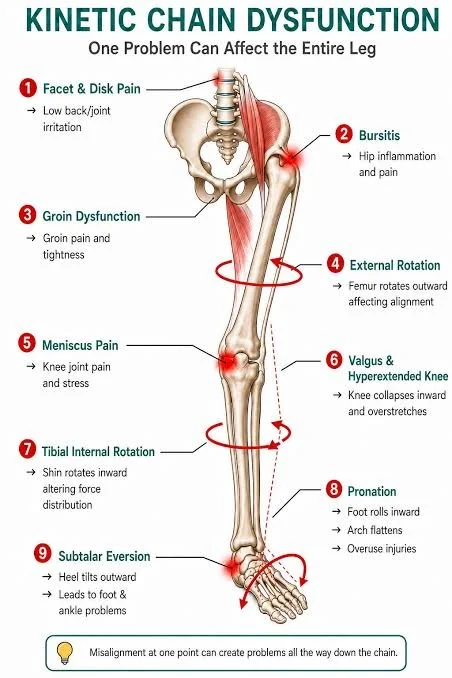
The carousel showed three common chains: ankle to knee, hip to lower back, upper back to shoulder. This article explains why they happen, what the research actually supports, where the idea gets oversold, and how you can check your own chain at home.
One of the most common things I hear from new clients is: “I’ve been treating this knee for two years and it keeps coming back.” The treatment helps, for a while. Then the pain returns, in the same place, often doing the same thing.
When that happens, it’s worth changing the question. Not “what’s wrong with my knee?” but “why is my knee doing this much work?”
1 · Regional interdependence: the idea behind the chain
In 2007, a group of physiotherapists gave this a name: regional interdependence. The idea is simple. A problem in one region of the body can contribute to symptoms in another, even one that seems unrelated (Wainner et al., 2007).
A later review described several ways this can happen, not only mechanical ones (Sueki et al., 2013):
Mechanical: when one joint moves less, a neighbour moves more.
Neurological: after an injury, the nervous system changes how it controls muscles well beyond the injured area.
Pain sensitivity: a sensitised nervous system can make a whole region more reactive.
Whole-person factors: sleep, stress and fear of movement change how much things hurt and how we move.
2 · The “joint-by-joint” map: useful, not a law
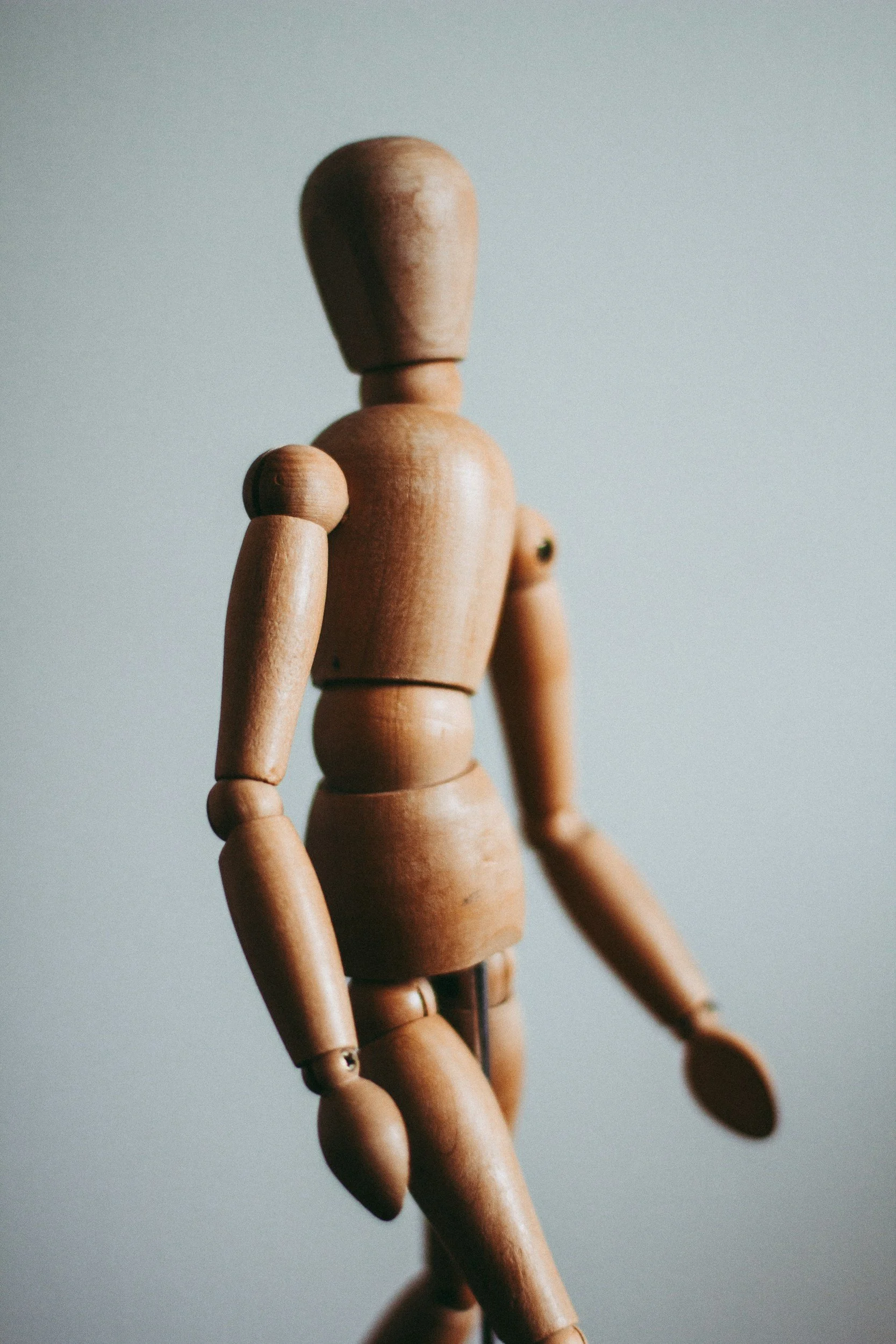
The carousel used a popular framework from coaches Mike Boyle and Gray Cook. It describes joints as alternating up the body between mostly needing mobility and mostly needing stability:
Foot: Stable (provides a stable base)
Ankle: Mobile (needs sagittal plane range of motion)
Knee: Stable (needs motor control and resistance to unwanted rotation)
Hip: Mobile (multi-planar ball-and-socket movement)
Lumbar Spine: Stable (requires anti-movement and core bracing)
Thoracic Spine: Mobile (requires rotation and extension)
Scapula: Stability (stabilizes the shoulder blade against the ribcage)
Glenohumeral (Shoulder): Mobile (wide range of motion)
A teaching map, not a research finding. Every joint needs both mobility and control.
It’s a helpful map for looking at a body, and I use it. But it’s a simplification. The knee needs plenty of mobility, and the hip needs plenty of stability. Treat it as a place to start looking, not as an explanation for every pain.
3 · Chain 1: ankle → knee
An ankle sprain often leaves the ankle with less dorsiflexion: the ability to bring the shin forward over the foot. You need that range every time you squat, climb stairs or land from a jump.
When it’s missing, something else has to give. In one study, researchers limited people’s ankle dorsiflexion with a wedge under their heels. During squats, their knees drifted inward more and the muscle activity around the knee and hip changed (Macrum et al., 2012).
There’s a neurological side too. After a severe ankle sprain, researchers found changes in how the hip muscles switched on, on both the injured and the uninjured side (Bullock-Saxton, 1994). The ankle heals; the way the nervous system organises the whole leg may not go back by itself.
What this looks like in real life
Old ankle sprain → stiff ankle → knee drifts in when you squat or run → knee pain months or years later
Very few people connect their knee to an ankle they sprained years ago.
“The pain appears where the compensation, the extra work, is happening. The problem lives where the original mobility was lost, where the work needs to be done in the first place.”
4 · Chain 2: hip → lower back
When the hip can’t extend (move the leg behind you) or rotate well, the lower back often moves instead. You can see this in a lunge where the back arches as the leg goes behind, or in a golf swing where the lower back twists because the hips don’t.
Studies have found that people with low back pain who play rotation-related sports tend to have less, or more uneven, hip rotation than those without pain (Van Dillen et al., 2008). That’s an association, not proof that the hip causes the pain. But it’s a good reason to check the hips when the back keeps hurting.
It also explains a common frustration: stretching your back every day and wondering why it doesn’t help. If the back is moving too much to make up for the hips, stretching it further isn’t the answer.
5 · Chain 3: upper back → shoulder
To lift your arm fully overhead, your shoulder blade needs to rotate and your upper back needs to extend slightly. A stiff upper back, from long hours at a desk for example, leaves the shoulder doing more of the job near the top of the range. That’s where many people feel a pinch.
In a clinical trial, people with shoulder impingement improved their pain and function after treatment to the upper back, without anything done directly to the shoulder (Boyles et al., 2009).
6 · The strongest example: knee pain treated at the hip
If you want one piece of evidence that looking upstream works, this is it. For pain at the front of the knee (patellofemoral pain), a systematic review found that strengthening the hip muscles, alone or with knee exercises, reduced pain and improved function, and did so faster than knee exercises alone (Lack et al., 2015).
That’s why a Pilates session that hardly touches your knee can still change how your knee feels.
7 · When the injury IS where the problem is
The carousel says “never”. In reality, it’s “not always”. Sometimes the problem really is where it hurts:
A clear accident. A fall, a twist, a direct blow.
Overload of the tissue itself. A tendon that has been asked to do too much, too soon, often needs carefully dosed loading right there.
Red flags. Night pain that doesn’t ease, swelling, numbness, weakness or feeling generally unwell need a medical check first.
Looking upstream is not instead of treating the painful area. It’s in addition to it, especially when something keeps coming back.
8 · Check your own chain (compare sides)
These quick checks don’t diagnose anything. They show you where to look. What matters most is the difference between left and right.
Ankle: knee-to-wall
Face a wall, one foot forward. Keep the heel down and bend the knee to touch the wall. Move the foot back until you can just touch it. Measure the distance from toes to wall on each side.
Hip: half-kneeling lunge
Kneel on one knee. Tuck the pelvis slightly and shift forward. Does the front of the back hip open, or does your lower back arch to get there? Compare sides.
Upper back: seated rotation
Sit on a chair, arms crossed on your chest, knees together. Turn to each side without moving your knees. How far do you go, and does one side feel blocked?
The whole chain: single-leg squat
In front of a mirror, do a small single-leg squat. Watch the knee, the hip and the trunk. Does one side drift, drop or twist more?
A clear difference between sides, especially on the side of your recurring pain, is worth showing to your teacher or physio.
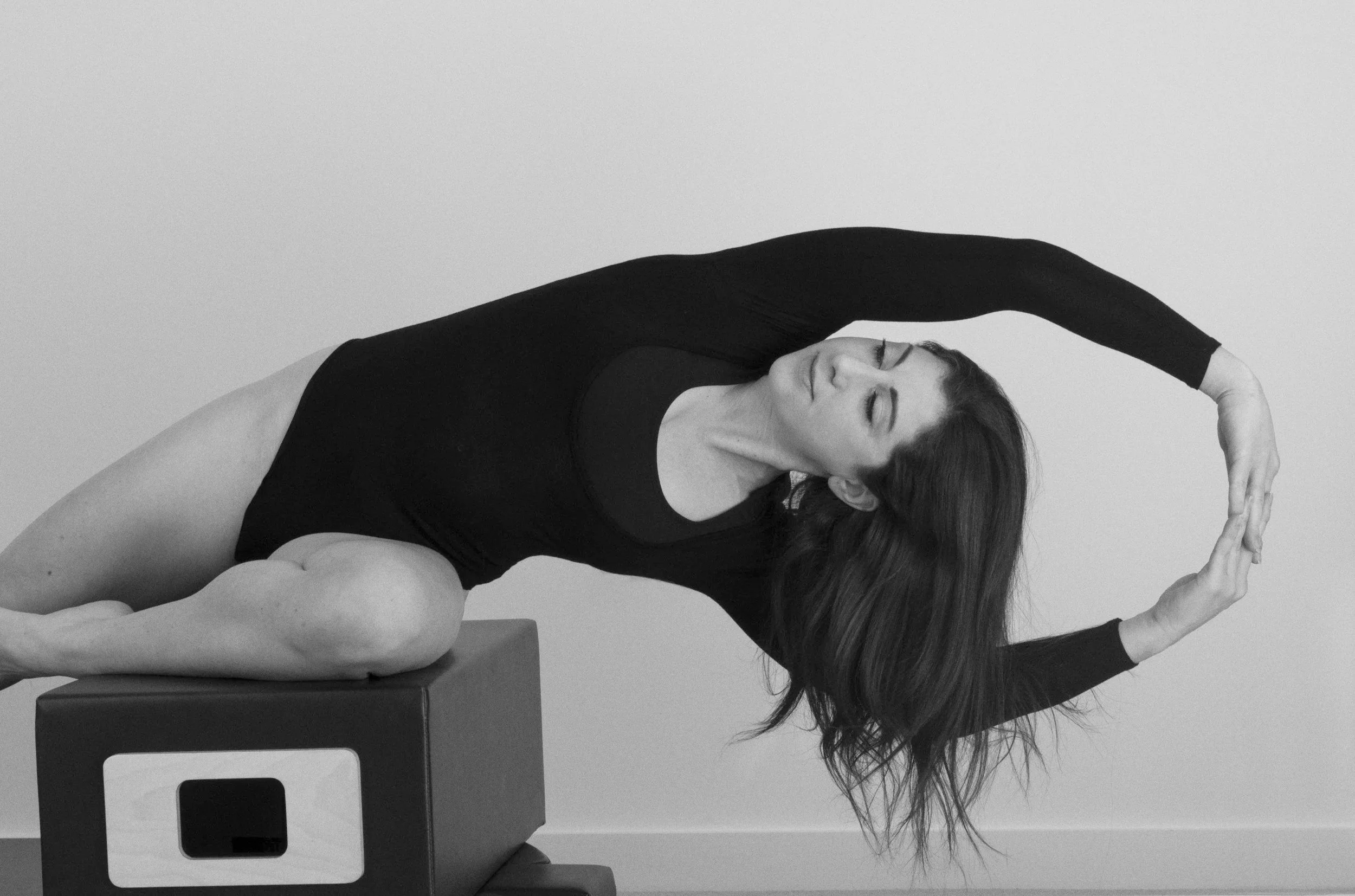
How I work on it during my sessions
We look at the whole chain before deciding what to work on. Then we do two things: restore the movement that’s missing, and load it, so the body actually uses the new range under real conditions.
On the reformer, that might be footwork and heel work for the ankle, scooter and lunges for hip extension, mermaid and seated rotation for the upper back. Stretching alone rarely changes a pattern. Range you can control, under load, usually does.
If something keeps coming back, ask where the movement is missing. Not just where you feel it.
Working through something that keeps coming back? This is how we assess and work in every session at Moow. Book a session.
References1. Wainner RS, Whitman JM, Cleland JA, Flynn TW. Regional interdependence: a musculoskeletal examination model whose time has come. J Orthop Sports Phys Ther. 2007;37(11):658–660.2. Sueki DG, Cleland JA, Wainner RS. A regional interdependence model of musculoskeletal dysfunction: research, mechanisms, and clinical implications. J Man Manip Ther. 2013;21(2):90–102.3. Boyle M. Advances in Functional Training. On Target Publications; 2010.4. Macrum E, Bell DR, Boling M, Lewek M, Padua D. Effect of limiting ankle-dorsiflexion range of motion on lower extremity kinematics and muscle-activation patterns during a squat. J Sport Rehabil. 2012;21(2):144–150.5. Bullock-Saxton JE. Local sensation changes and altered hip muscle function following severe ankle sprain. Phys Ther. 1994;74(1):17–28.6. Van Dillen LR et al. Hip rotation range of motion in people with and without low back pain who participate in rotation-related sports. Phys Ther Sport. 2008;9(2):72–81.7. Boyles RE, Ritland BM, Miracle BM, et al. The short-term effects of thoracic spine thrust manipulation on patients with shoulder impingement syndrome. Man Ther. 2009;14(4):375–380.8. Lack S, Barton C, Sohan O, Crossley K, Morrissey D. Proximal muscle rehabilitation is effective for patellofemoral pain: a systematic review with meta-analysis. Br J Sports Med. 2015;49(21):1365–1375