
Where you carry your weight changes everything: Centre of Mass and Joint loading
The Instagram version of this post says your centre of mass decides what your joints have to do. That's true, but it's only the headline. This article covers the mechanism behind it, a few things the posture world gets wrong, and what we actually do with it in a session.
1 · A point that isn't in your body
Your centre of mass (CoM) is the average position of all your mass. It isn't an organ or a bone. It's a mathematical point. Standing upright, it sits a little over half your height from the floor, roughly in front of the second sacral vertebra. It tends to sit slightly lower in women than in men because of how mass is distributed between pelvis and upper body.
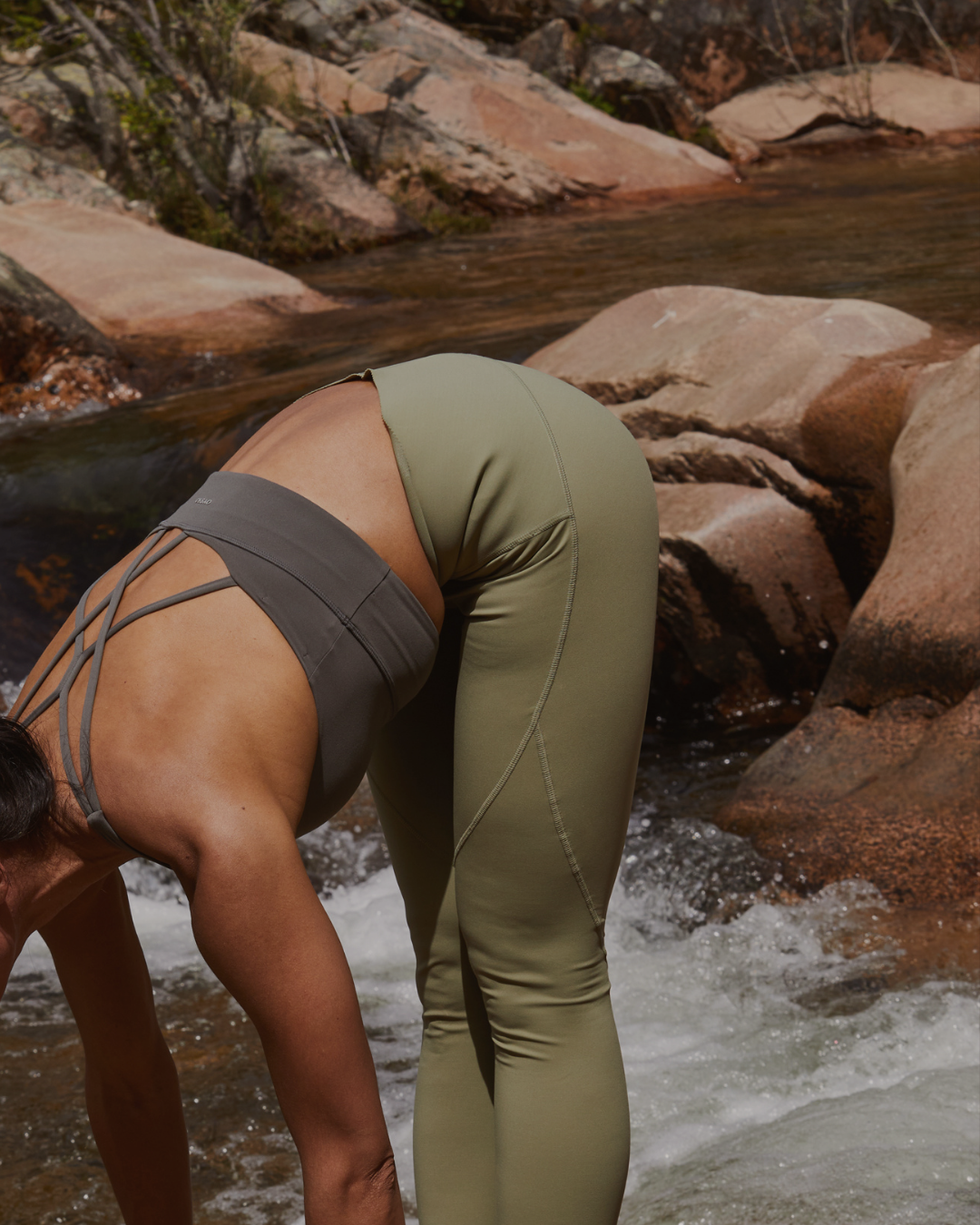
The interesting part is that it moves. Raise your arms and it rises. Bend forward to touch your toes and it can end up outside your body, somewhere in the air in front of your pelvis. A high jumper doing a Fosbury flop arches over the bar while their CoM passes under it. Your CoM isn't a fixed place you carry. It's the result of how you arrange your segments at any given moment.
2 · Balance: centre of mass vs centre of pressure
Draw a vertical line down from your CoM to the floor. That's your line of gravity. To stay upright, that line needs to fall within your base of support, the area under and between your feet.
But standing still is never actually still. Your body behaves like an inverted pendulum, a stick balanced on its end, constantly falling a little and being caught. The way it catches itself is by moving the centre of pressure (CoP), the point under your feet where the floor pushes back. Your ankles, toes and hips continuously shift the CoP slightly ahead of and behind the CoM so it never drifts too far. Biomechanists call the small movements this produces postural sway. In a healthy system the sway is constant, small and adaptable (Winter, 1995).
For small disturbances, the system mostly uses the ankles: the whole body rocks over the feet like one rigid block. For bigger or faster disturbances, or on a narrow surface, it switches to the hips, bending at the waist to throw the upper body the other way (Horak & Nashner, 1986). If neither is enough, you take a step and make a new base of support.
Balance isn't holding a position. It's the CoP chasing the CoM, hundreds of times a minute. That's a skill, and skills are trainable.
3 · Where joint load really comes from: the moment arm
This is the piece that turns "your CoM matters" from a slogan into something you can use.
Around every joint, gravity and the ground reaction force create a turning effect called a moment (or torque). Its size is the force multiplied by its moment arm: the horizontal distance between the line of that force and the joint's centre. Your muscles have to produce an equal and opposite moment to hold the position. Muscles sit very close to the joints they cross, so they have short moment arms of their own. They often have to pull with forces several times body weight to balance a modest external moment. That muscle force is a big part of what compresses the joint.
So the question isn't "where is my weight?" in the abstract. It's how far is the line of force from each joint? Move the CoM and you redistribute those distances, and with them the work, between ankle, knee, hip and spine.
knee: long armhip: shortUpright trunk, knees forwardknee: shorthip: long armTrunk leaning, shins verticaldashed line = line of gravity through the CoM, over mid-foot in both
Same squat depth, same body, same balance point. The only change is how the segments are arranged, and that decides whether the knee or the hip does more of the work.
The squat is the clearest example. Keep your trunk upright and let your knees travel forward, and the knee sits far from the line of gravity: the quadriceps work hard and the knee carries more load. Lean the trunk forward and keep the shins more vertical, and the hip sits far from the line instead: the glutes and hamstrings take over. When Fry and colleagues (2003) restricted forward knee travel in a barbell squat, knee torque dropped and hip torque rose sharply. Neither version is "correct". They're two ways to share the same job.
That's why "knees must never go past your toes" is a rule worth dropping. It doesn't remove load. It moves it, mostly to the hips and lower back. Whether that's a good idea depends on the person, not on the rule.
4 · Real-life examples worth noticing
Sit-to-stand
You can't stand up from a chair until you bring your CoM forward over your feet → that's why we lean forward first, or tuck the feet under → people with painful knees often lean much further, moving load from knee to hip
Watching how someone gets out of a chair tells you which joint they're protecting.
Carrying a bag on one side
The combined CoM shifts toward the bag → the trunk leans away to bring it back over the feet → the opposite-side hip abductors and trunk side-benders work harder
Nothing wrong with it. It's simply a load. Switching sides varies it.
Pregnancy
The growing abdomen moves the CoM forward → the lumbar curve increases to bring it back over the hips → the female lumbar spine has evolved adaptations that make this extra curve less costly (Whitcome et al., 2007)
One of the clearest examples of the body reorganising around its CoM, and why "fix the arch" is the wrong goal in pregnancy.
Running
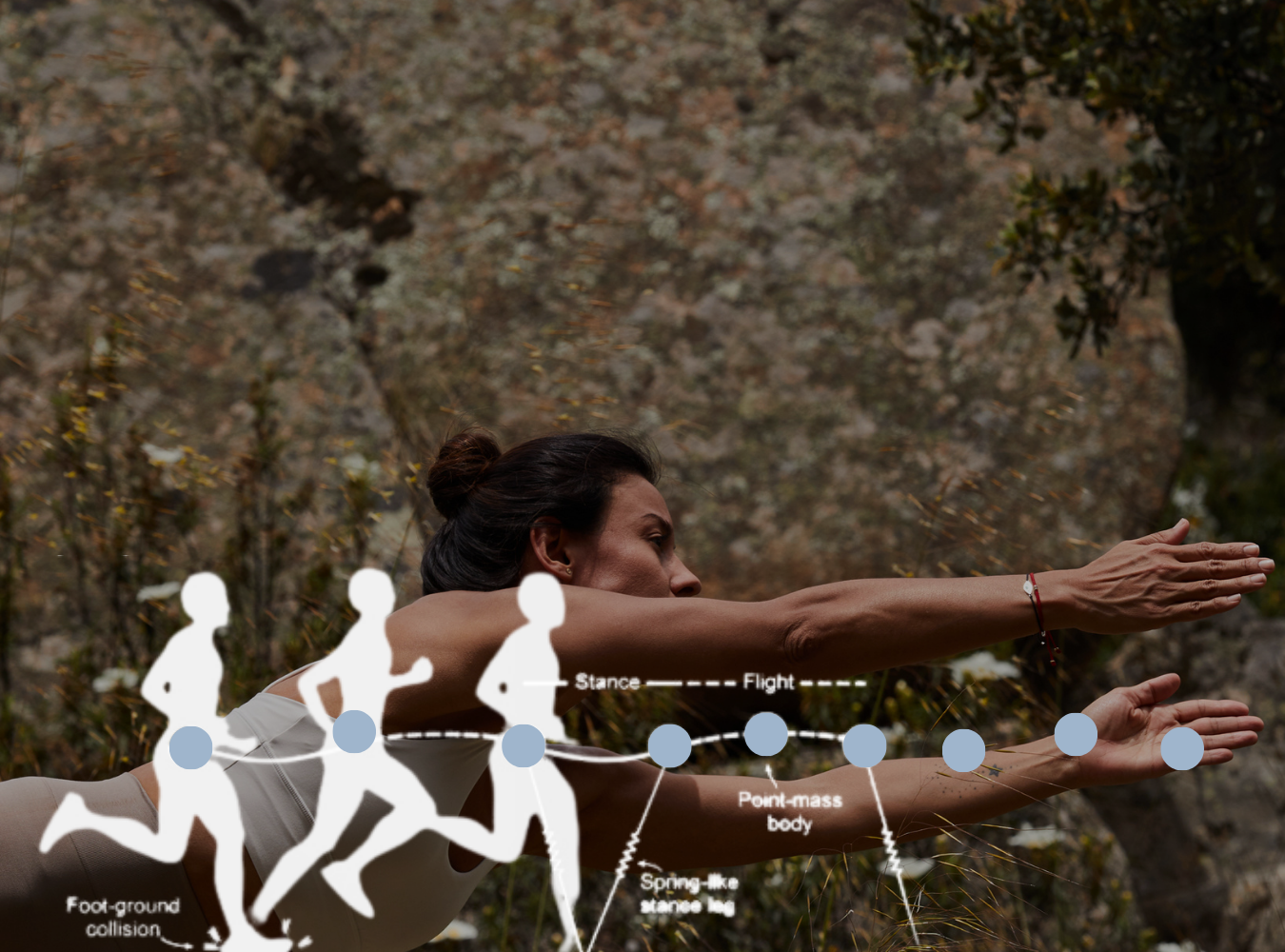
The CoM rises and falls with every step → long strides that land far in front of the CoM increase braking and knee load → a modest 5–10% increase in step rate lowers the load absorbed at the knee and hip (Heiderscheit et al., 2011)
Less vertical oscillation is also associated with better running economy (Folland et al., 2017).
5 · What the posture world gets wrong
This is where we need to be honest, including about our own Instagram slides.
The "your head weighs 27 kg" numbers come from a model, not a measurement. Hansraj (2014) calculated that tilting the head forward by 15°, 30°, 45° and 60° would raise the effective load on the neck from about 5 kg to roughly 12, 18, 22 and 27 kg. It's a useful illustration of moment arms, but it's a simplified calculation and it says nothing about harm. Neck tissues are built to handle load, and they adapt to it.

Posture is a weak predictor of pain. A large review of systematic reviews found no consistent evidence that spinal posture causes low back pain (Swain et al., 2020). People with and without back pain show largely overlapping lumbar curves (Laird et al., 2014). An anterior pelvic tilt is a position, not a diagnosis. Neither are knees that drift inward on a single-leg squat.
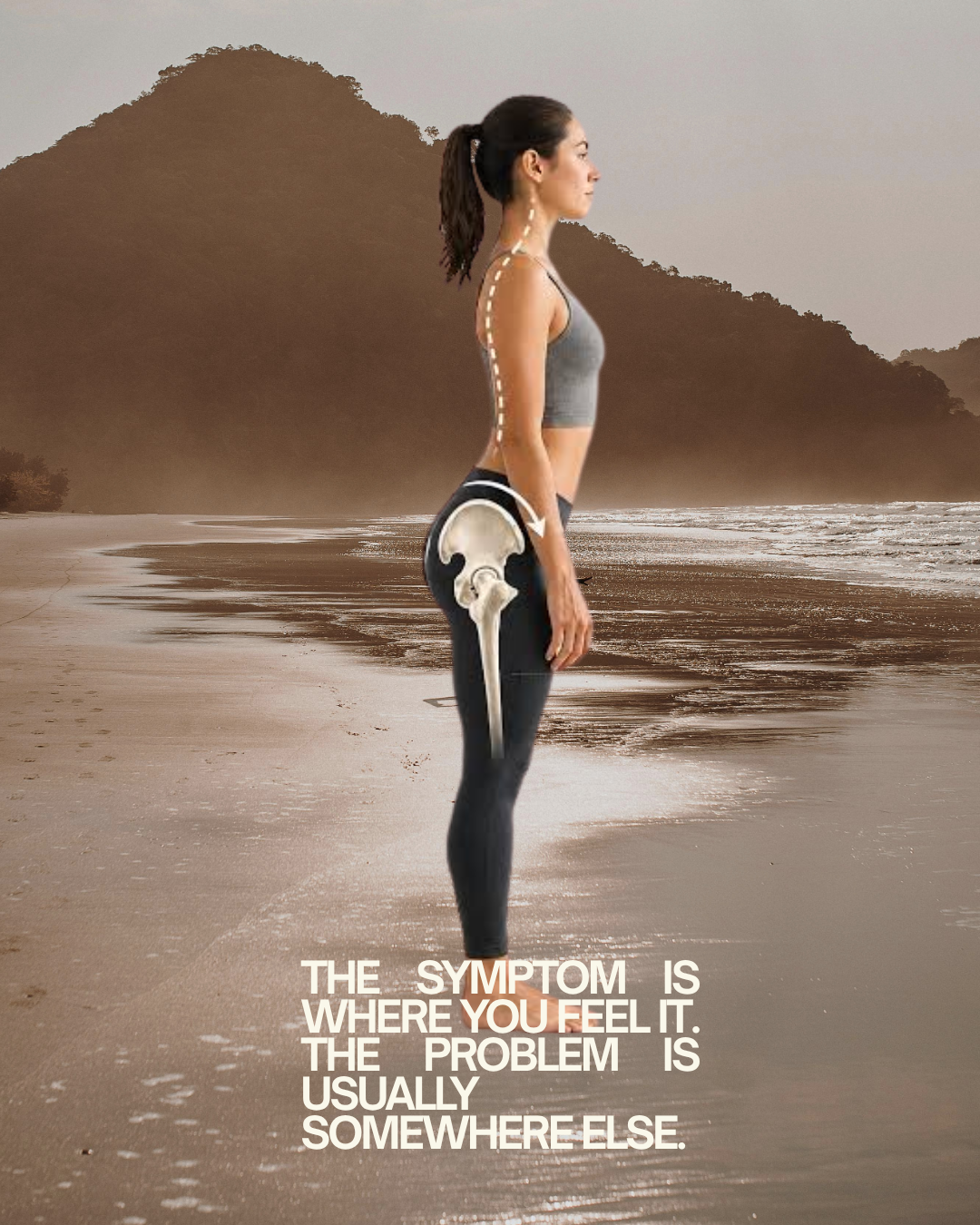
So when we say "the symptom is where you feel it, the problem is usually somewhere else", we don't mean there's one perfect alignment and every deviation is damage. We mean that load is shared across the whole chain, and a body that can only share it one way has fewer options when that way gets tired, irritated or injured.
The goal isn't the perfect position. It's having many positions available, and the capacity to load each of them.
6 · What this looks like on the reformer
The reformer is unusually good at this work, because the moving carriage and springs make the CoM and the CoP impossible to fake.
Footwork. Lying down, you take balance out of the equation, so you can see how each leg shares load. Change the foot position (heels, arches, toes) and you shift the moment arm between ankle, knee and hip without changing anything else. Asymmetries show up as a carriage that drifts or a pelvis that rotates.
Standing work: side splits, scooter, standing lunge. Here the base of support itself is moving. The CoM has to stay over a base that changes width under spring tension. This is CoP–CoM control in its purest form, with feedback that's immediate and honest.
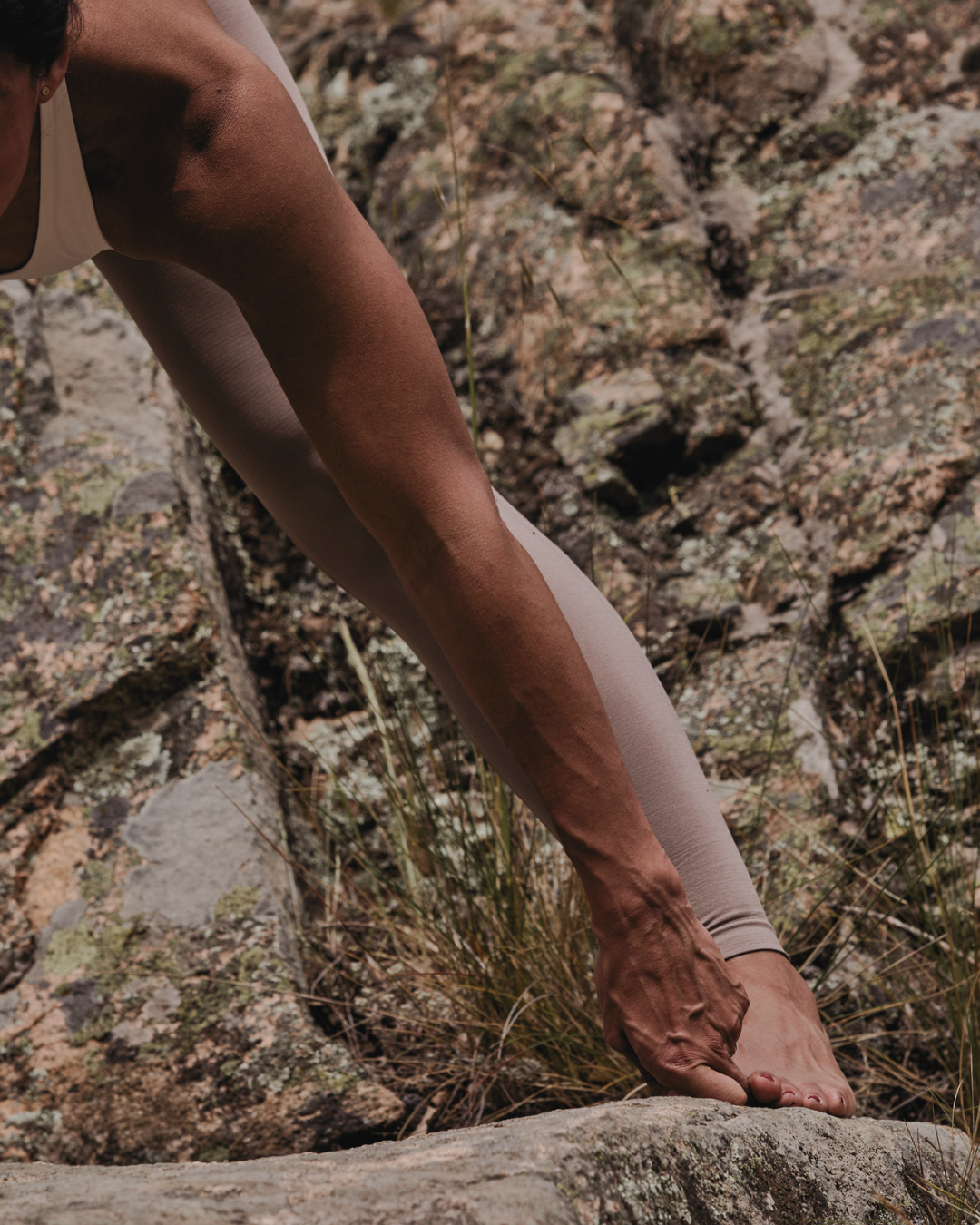
Same exercise, different arrangement. In a lunge or a squat on the reformer, we deliberately change trunk angle and knee travel to move the work between hip and knee. That's useful when one joint is irritated, and it's also good training for the joint that's been avoiding the work.
Spring as information, not just resistance. A lighter spring is often harder for balance, because the carriage moves with less provocation. Changing spring load is a way to change the stability demand, not only the strength demand.
7 · Try this today
Stand barefoot and close your eyes for thirty seconds. Notice where the pressure sits under your feet: heels, balls of the feet, inside or outside edge, more on one side. Then slowly lean forward from the ankles until your toes have to grip, and back until your heels take over. That range is your CoP at work. Now do a few squats to a chair, first letting your knees travel forward, then sitting back with a more vertical shin. Notice where you feel the effort change.
You've just moved your moment arms on purpose. That noticing is already training.
REFERENCES1. Winter DA. Human balance and posture control during standing and walking. Gait Posture. 1995;3(4):193–214.2. Horak FB, Nashner LM. Central programming of postural movements: adaptation to altered support-surface configurations. J Neurophysiol. 1986;55(6):1369–1381.3. Fry AC, Smith JC, Schilling BK. Effect of knee position on hip and knee torques during the barbell squat. J Strength Cond Res. 2003;17(4):629–633.4. Whitcome KK, Shapiro LJ, Lieberman DE. Fetal load and the evolution of lumbar lordosis in bipedal hominins. Nature. 2007;450:1075–1078.5. Heiderscheit BC et al. Effects of step rate manipulation on joint mechanics during running. Med Sci Sports Exerc. 2011;43(2):296–302.6. Folland JP et al. Running technique is an important component of running economy and performance. Med Sci Sports Exerc. 2017;49(7):1412–1423.7. Hansraj KK. Assessment of stresses in the cervical spine caused by posture and position of the head. Surg Technol Int. 2014;25:277–279.8. Swain CTV et al. No consensus on causality of spine postures or physical exposure and low back pain: a systematic review of systematic reviews. J Biomech. 2020;102:109312.9. Laird RA et al. Comparing lumbo-pelvic kinematics in people with and without back pain: a systematic review and meta-analysis. BMC Musculoskelet Disord. 2014;15:229.Want to see how your body shares its load? This is the kind of work we do in every session 1-on-1.
More on the About page.Where you carry your weight changes everything: centre of mass, moment arms and joint load
By Elena · @moowpilates · 13 October 2026 · Body & Anatomy
The Instagram version of this post says your centre of mass decides what your joints have to do. That's true, but it's only the headline. This article covers the mechanism behind it, a few things the posture world gets wrong, and what we actually do with it in a session.
1 · A point that isn't in your body
Your centre of mass (CoM) is the average position of all your mass. It isn't an organ or a bone. It's a mathematical point. Standing upright, it sits a little over half your height from the floor, roughly in front of the second sacral vertebra. It tends to sit slightly lower in women than in men because of how mass is distributed between pelvis and upper body.
The interesting part is that it moves. Raise your arms and it rises. Bend forward to touch your toes and it can end up outside your body, somewhere in the air in front of your pelvis. A high jumper doing a Fosbury flop arches over the bar while their CoM passes under it. Your CoM isn't a fixed place you carry. It's the result of how you arrange your segments at any given moment.
2 · Balance: centre of mass vs centre of pressure
Draw a vertical line down from your CoM to the floor. That's your line of gravity. To stay upright, that line needs to fall within your base of support, the area under and between your feet.
But standing still is never actually still. Your body behaves like an inverted pendulum, a stick balanced on its end, constantly falling a little and being caught. The way it catches itself is by moving the centre of pressure (CoP), the point under your feet where the floor pushes back. Your ankles, toes and hips continuously shift the CoP slightly ahead of and behind the CoM so it never drifts too far. Biomechanists call the small movements this produces postural sway. In a healthy system the sway is constant, small and adaptable (Winter, 1995).
For small disturbances, the system mostly uses the ankles: the whole body rocks over the feet like one rigid block. For bigger or faster disturbances, or on a narrow surface, it switches to the hips, bending at the waist to throw the upper body the other way (Horak & Nashner, 1986). If neither is enough, you take a step and make a new base of support.
Balance isn't holding a position. It's the CoP chasing the CoM, hundreds of times a minute. That's a skill, and skills are trainable.
3 · Where joint load really comes from: the moment arm
This is the piece that turns "your CoM matters" from a slogan into something you can use.
Around every joint, gravity and the ground reaction force create a turning effect called a moment (or torque). Its size is the force multiplied by its moment arm: the horizontal distance between the line of that force and the joint's centre. Your muscles have to produce an equal and opposite moment to hold the position. Muscles sit very close to the joints they cross, so they have short moment arms of their own. They often have to pull with forces several times body weight to balance a modest external moment. That muscle force is a big part of what compresses the joint.
So the question isn't "where is my weight?" in the abstract. It's how far is the line of force from each joint? Move the CoM and you redistribute those distances, and with them the work, between ankle, knee, hip and spine.
knee: long armhip: shortUpright trunk, knees forwardknee: shorthip: long armTrunk leaning, shins verticaldashed line = line of gravity through the CoM, over mid-foot in both
Same squat depth, same body, same balance point. The only change is how the segments are arranged, and that decides whether the knee or the hip does more of the work.
The squat is the clearest example. Keep your trunk upright and let your knees travel forward, and the knee sits far from the line of gravity: the quadriceps work hard and the knee carries more load. Lean the trunk forward and keep the shins more vertical, and the hip sits far from the line instead: the glutes and hamstrings take over. When Fry and colleagues (2003) restricted forward knee travel in a barbell squat, knee torque dropped and hip torque rose sharply. Neither version is "correct". They're two ways to share the same job.
That's why "knees must never go past your toes" is a rule worth dropping. It doesn't remove load. It moves it, mostly to the hips and lower back. Whether that's a good idea depends on the person, not on the rule.
4 · Real-life examples worth noticing
Sit-to-stand
You can't stand up from a chair until you bring your CoM forward over your feet → that's why we lean forward first, or tuck the feet under → people with painful knees often lean much further, moving load from knee to hip
Watching how someone gets out of a chair tells you which joint they're protecting.
Carrying a bag on one side
The combined CoM shifts toward the bag → the trunk leans away to bring it back over the feet → the opposite-side hip abductors and trunk side-benders work harder
Nothing wrong with it. It's simply a load. Switching sides varies it.
Pregnancy
The growing abdomen moves the CoM forward → the lumbar curve increases to bring it back over the hips → the female lumbar spine has evolved adaptations that make this extra curve less costly (Whitcome et al., 2007)
One of the clearest examples of the body reorganising around its CoM, and why "fix the arch" is the wrong goal in pregnancy.
Running
The CoM rises and falls with every step → long strides that land far in front of the CoM increase braking and knee load → a modest 5–10% increase in step rate lowers the load absorbed at the knee and hip (Heiderscheit et al., 2011)
Less vertical oscillation is also associated with better running economy (Folland et al., 2017).
5 · What the posture world gets wrong
This is where we need to be honest, including about our own Instagram slides.
The "your head weighs 27 kg" numbers come from a model, not a measurement. Hansraj (2014) calculated that tilting the head forward by 15°, 30°, 45° and 60° would raise the effective load on the neck from about 5 kg to roughly 12, 18, 22 and 27 kg. It's a useful illustration of moment arms, but it's a simplified calculation and it says nothing about harm. Neck tissues are built to handle load, and they adapt to it.
Posture is a weak predictor of pain. A large review of systematic reviews found no consistent evidence that spinal posture causes low back pain (Swain et al., 2020). People with and without back pain show largely overlapping lumbar curves (Laird et al., 2014). An anterior pelvic tilt is a position, not a diagnosis. Neither are knees that drift inward on a single-leg squat.
So when we say "the symptom is where you feel it, the problem is usually somewhere else", we don't mean there's one perfect alignment and every deviation is damage. We mean that load is shared across the whole chain, and a body that can only share it one way has fewer options when that way gets tired, irritated or injured.
The goal isn't the perfect position. It's having many positions available, and the capacity to load each of them.
6 · What this looks like on the reformer
The reformer is unusually good at this work, because the moving carriage and springs make the CoM and the CoP impossible to fake.
Footwork. Lying down, you take balance out of the equation, so you can see how each leg shares load. Change the foot position (heels, arches, toes) and you shift the moment arm between ankle, knee and hip without changing anything else. Asymmetries show up as a carriage that drifts or a pelvis that rotates.
Standing work: side splits, scooter, standing lunge. Here the base of support itself is moving. The CoM has to stay over a base that changes width under spring tension. This is CoP–CoM control in its purest form, with feedback that's immediate and honest.
Same exercise, different arrangement. In a lunge or a squat on the reformer, we deliberately change trunk angle and knee travel to move the work between hip and knee. That's useful when one joint is irritated, and it's also good training for the joint that's been avoiding the work.
Spring as information, not just resistance. A lighter spring is often harder for balance, because the carriage moves with less provocation. Changing spring load is a way to change the stability demand, not only the strength demand.
7 · Try this today
Stand barefoot and close your eyes for thirty seconds. Notice where the pressure sits under your feet: heels, balls of the feet, inside or outside edge, more on one side. Then slowly lean forward from the ankles until your toes have to grip, and back until your heels take over. That range is your CoP at work. Now do a few squats to a chair, first letting your knees travel forward, then sitting back with a more vertical shin. Notice where you feel the effort change.
You've just moved your moment arms on purpose. That noticing is already training.
References
1. Winter DA. Human balance and posture control during standing and walking. Gait Posture. 1995;3(4):193–214.
2. Horak FB, Nashner LM. Central programming of postural movements: adaptation to altered support-surface configurations. J Neurophysiol. 1986;55(6):1369–1381.
3. Fry AC, Smith JC, Schilling BK. Effect of knee position on hip and knee torques during the barbell squat. J Strength Cond Res. 2003;17(4):629–633.
4. Whitcome KK, Shapiro LJ, Lieberman DE. Fetal load and the evolution of lumbar lordosis in bipedal hominins. Nature. 2007;450:1075–1078.
5. Heiderscheit BC et al. Effects of step rate manipulation on joint mechanics during running. Med Sci Sports Exerc. 2011;43(2):296–302.
6. Folland JP et al. Running technique is an important component of running economy and performance. Med Sci Sports Exerc. 2017;49(7):1412–1423.
7. Hansraj KK. Assessment of stresses in the cervical spine caused by posture and position of the head. Surg Technol Int. 2014;25:277–279.
8. Swain CTV et al. No consensus on causality of spine postures or physical exposure and low back pain: a systematic review of systematic reviews. J Biomech. 2020;102:109312.
9. Laird RA et al. Comparing lumbo-pelvic kinematics in people with and without back pain: a systematic review and meta-analysis. BMC Musculoskelet Disord. 2014;15:229.
Want to see how your body shares its load? This is the kind of work we do in every session at Moow. More on the About page.
