
The carousel named four mechanisms. This article goes into what the research shows for each one, corrects one thing we oversimplified, adds the muscle runners most often forget, and ends with how to plan Pilates around your running.
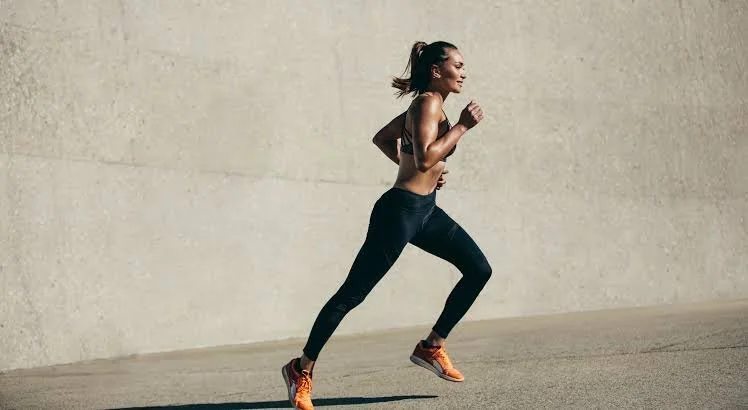
1 · What actually makes a runner faster: running economy
Running economy is how much oxygen you use to run at a given pace. Two runners with the same fitness can perform very differently because one wastes less energy per stride. Better economy means the same pace feels easier, or you can hold a faster pace for longer.
Economy depends on three things: your mechanics, how efficiently your nervous system recruits muscles, and how stiff and springy your legs are (how well tendons store and return energy). Running more improves it slowly. Strength work improves it faster: a meta-analysis in highly trained runners found that adding strength training improved running economy (Balsalobre-Fernández et al., 2016).
Pilates has been tested directly too. In a study of trained runners, 12 weeks of Pilates improved 5 km performance and lowered the energy cost of running compared with a control group (Finatto et al., 2018). It’s one study, but it points the same way as the wider strength research.
2 · A correction: who actually pushes you forward
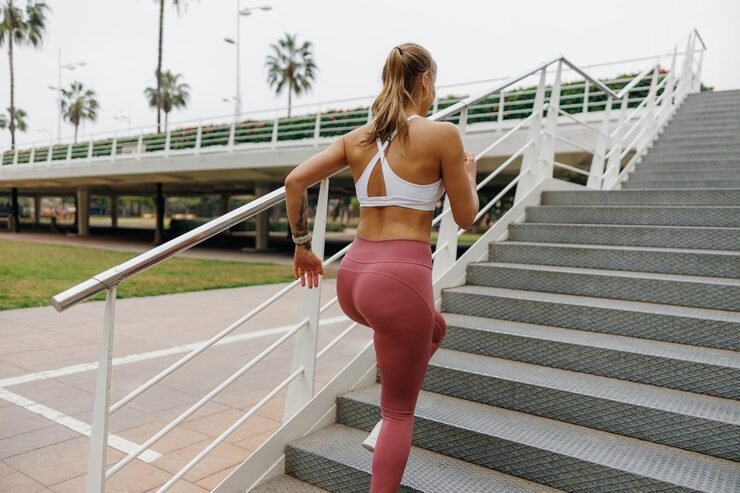
The carousel called the gluteus maximus “the primary propulsive muscle” in running. That’s an oversimplification, and it’s worth fixing.
When researchers modelled the forces of each muscle during running, the calf muscles (soleus and gastrocnemius) did most of the work supporting the body and pushing it forward. The soleus alone produced forces of several times body weight at every step. The glutes contributed too, and more so as speed increased, while the hamstrings worked hard at the end of each swing (Dorn et al., 2012).
Glutes matter. But for most runners, the calves are the engine, and they are rarely trained as one.
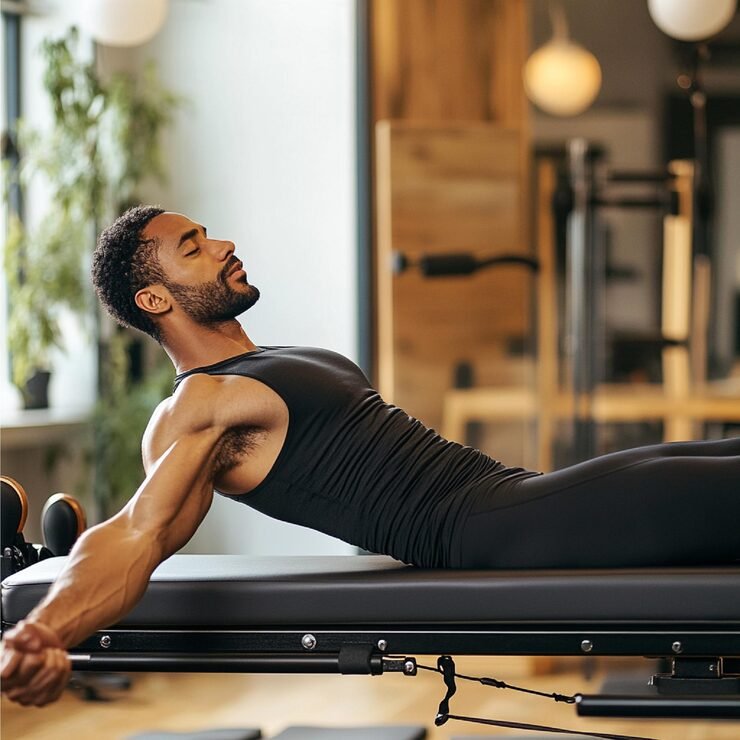
This is good news for Pilates. Footwork on the reformer, especially single-leg heel raises on heavier springs and slow lowering, is one of the most direct ways to build calf capacity without impact.
3 · Single-leg stability: the pelvis at every step
Running is a series of single-leg landings. At each one, the hip muscles on the standing side stop the pelvis from dropping towards the other side.
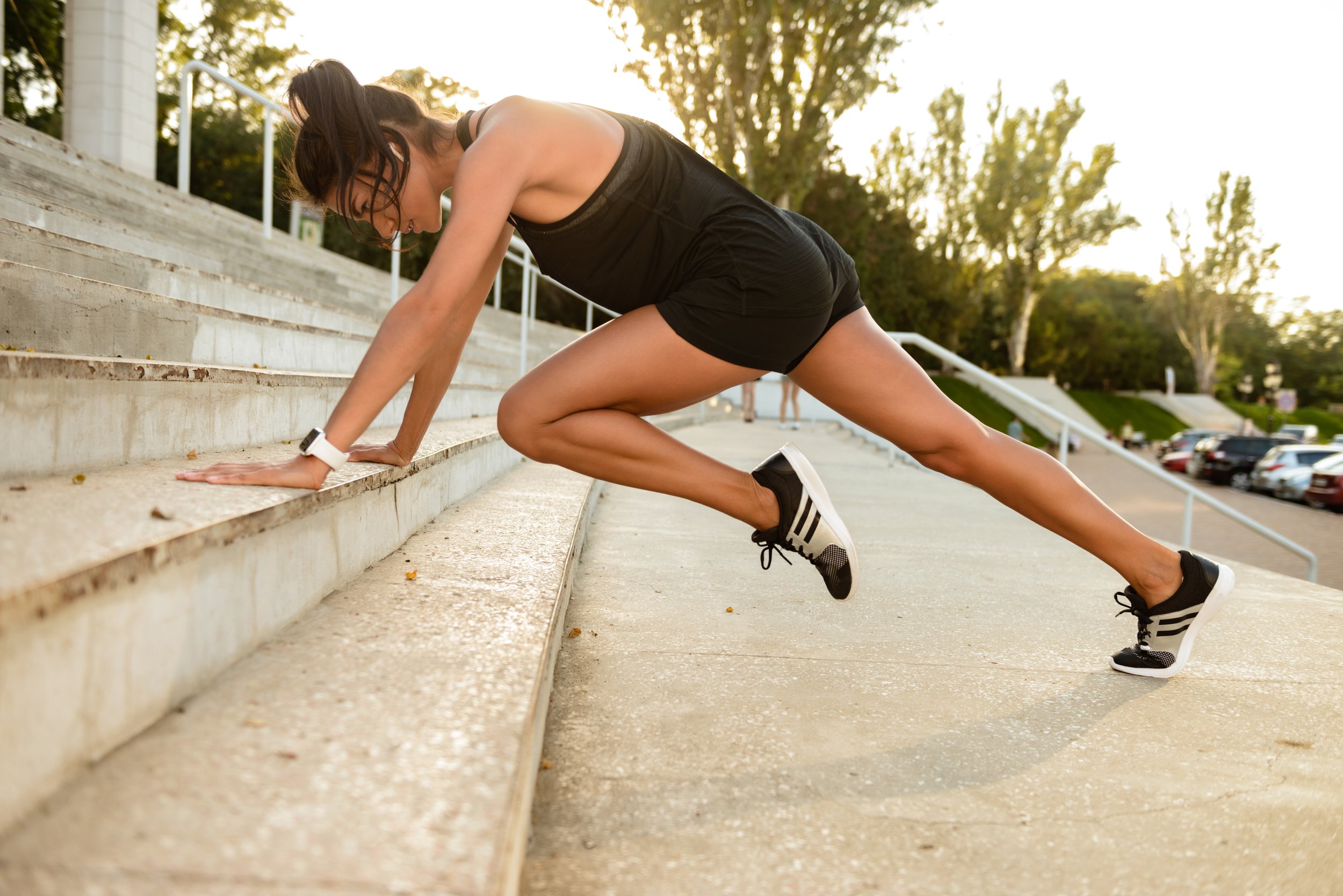
When that control is weak, the pelvis drops more. A study of injured and uninjured runners found that a larger contralateral pelvic drop was one of the clearest differences in runners with common soft-tissue injuries (Bramah et al., 2018). Weakness of the hip abductors has also been linked with problems like iliotibial band syndrome (Ferber et al., 2010).
A note on honesty: most of this research shows association, and studies following runners over time are mixed on whether weakness causes injury. What is clear is that strengthening the hip muscles helps people with knee pain from running (Lack et al., 2015).
In Pilates, this means standing work on a moving carriage (side splits, scooter, single-leg footwork), side-lying leg series, and anything that asks one leg to hold the pelvis steady while the other moves.
Another apparatus I especially like for runners is the Wunda Chair. Pushing down on the pedal with one leg gives a lot of information about how stable the pelvis stays, and how well the rest of the body manages its alignment, both as you press the pedal down (the concentric phase) and as you control it on the way back up (the eccentric phase). With a single foot on a narrow pedal and no carriage to hide behind, any drop of the pelvis, collapse of the knee or twist of the trunk shows up straight away. That makes it both a great assessment and a great training tool.
4 · Hip extension at push-off
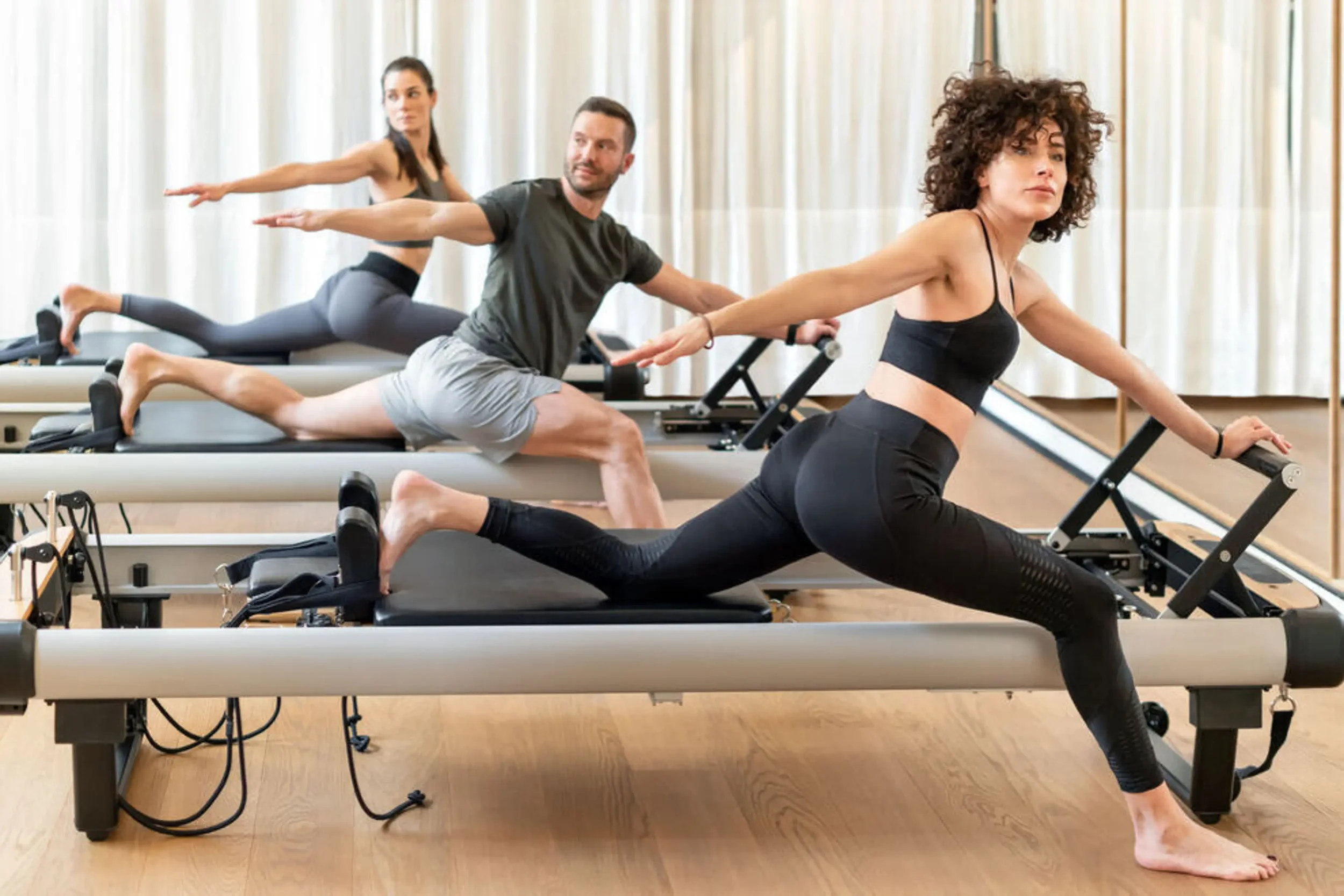
At push-off, the leg needs to extend behind you. If the front of the hip is stiff, or the glutes don’t use the range they have, the lower back often arches to make up for it. The stride gets shorter, and more load lands on the spine.
Pilates trains this in two steps. First the range: lunges, scooter and kneeling hip-opening work. Then strength in that range: arabesque, prone leg work and single-leg pressing. Range you can’t control won’t show up in your running. Range you can load usually does.
5 · Breathing under effort
Breathing is work. During hard efforts, the muscles of breathing can fatigue and compete with the legs for blood flow. Specific breathing-muscle training has been shown to improve endurance performance modestly (Illi et al., 2012).
Let’s be precise: Pilates breathing isn’t the same as that kind of training, and we don’t have evidence that it raises your VO2 max. What it does do is keep the ribcage mobile, teach you to breathe into the back and sides of the ribs, and practise breathing while the trunk is working. Many runners find that a relaxed, well-coordinated breath holds up better when they’re tired.
6 · Fewer injuries: the most underrated benefit
Most running injuries come from load that rises faster than tissues can adapt. You can’t control everything, but you can raise the capacity of those tissues.
A meta-analysis of injury-prevention programmes found that strength training cut sports injuries to less than a third, while stretching had no measurable effect (Lauersen et al., 2014). Pilates on the reformer, with real spring load, is can contribute to your strength training programme. That’s its biggest value for runners.
7 · How to fit Pilates into a running week
A practical plan
How often: 2 sessions a week. 1 is enough to maintain during heavy training blocks.
When: after an easy run or on an easy day. Avoid the day before a key workout or race, and the morning after your long run.
Load: not only light springs. Heavier footwork and single-leg work build the capacity that running needs.
Speed: include some jumpboard or small rebounds. Running is springy; your training should be too.
Taper: keep sessions in race week, but shorter and lighter.
What a runner-focused session includes
Single-leg footwork with slow lowering (calves) → side splits and scooter (hip stability, hip extension) → arabesque and prone work (posterior chain) → rotation and side bending (trunk) → jumpboard (elastic stiffness)
8 · What Pilates won’t do
It won’t replace running. Your aerobic fitness and running skill come from running. It won’t magically change your foot strike either.
What it does is fill the gaps running can’t: strength through range, single-leg control, calf capacity and a trunk that holds up when you’re tired.
The Pilates work doesn’t compete with your training. It makes the training you already do count for more.
References1. Balsalobre-Fernández C, Santos-Concejero J, Grivas GV. Effects of strength training on running economy in highly trained runners: a systematic review with meta-analysis of controlled trials. J Strength Cond Res. 2016;30(8):2361–2368.2. Finatto P et al. Pilates training improves 5-km run performance by changing metabolic cost and muscle activity in trained runners. PLoS One. 2018;13(3):e0194057.3. Dorn TW, Schache AG, Pandy MG. Muscular strategy shift in human running: dependence of running speed on hip and ankle muscle performance. J Exp Biol. 2012;215(11):1944–1956.4. Bramah C, Preece SJ, Gill N, Herrington L. Is there a pathological gait associated with common soft tissue running injuries? Am J Sports Med. 2018;46(12):3023–3031.5. Ferber R, Noehren B, Hamill J, Davis IS. Competitive female runners with a history of iliotibial band syndrome demonstrate atypical hip and knee kinematics. J Orthop Sports Phys Ther. 2010;40(2):52–58.6. Lack S, Barton C, Sohan O, Crossley K, Morrissey D. Proximal muscle rehabilitation is effective for patellofemoral pain: a systematic review with meta-analysis. Br J Sports Med. 2015;49(21):1365–1376.7. Illi SK, Held U, Frank I, Spengler CM. Effect of respiratory muscle training on exercise performance in healthy individuals: a systematic review and meta-analysis. Sports Med. 2012;42(8):707–724.8. Lauersen JB, Bertelsen DM, Andersen LB. The effectiveness of exercise interventions to prevent sports injuries: a systematic review and meta-analysis of randomised controlled trials. Br J Sports Med. 2014;48(11):871–877.