
Ask someone to show you a core exercise and they’ll almost always bend forward or hold a plank. Very few will twist. Yet every step you take is a small rotation, and the way your connective tissue is organised across your back is diagonal. This article explains where rotation really comes from, why your right arm and left leg are working on the same line, and how to train it with intention.
1 · Walking is a twist
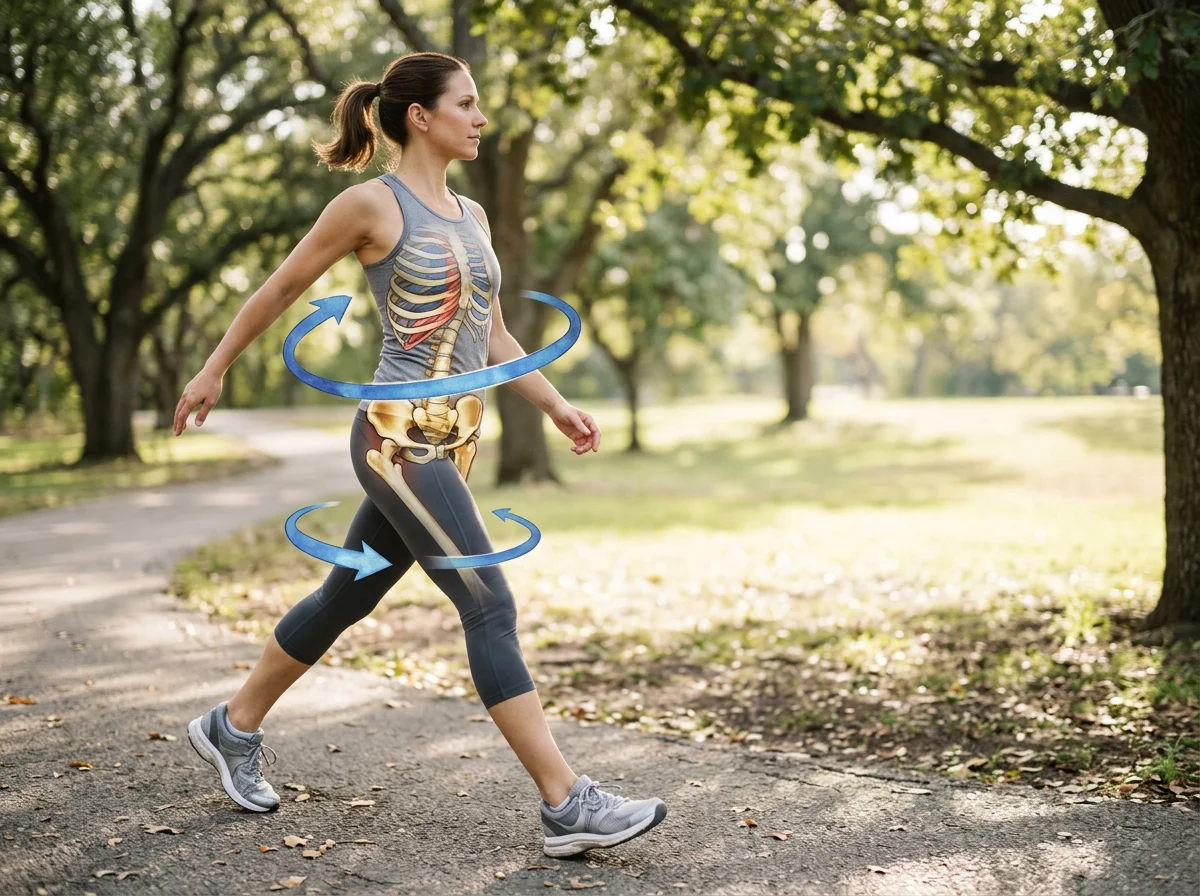
When you walk, your pelvis rotates forward with the swinging leg while your ribcage rotates the other way, and your arms swing in opposition to your legs. This counter-rotation keeps your body from spinning with each step and smooths the movement of your centre of mass.
It also saves energy. In an elegant experiment, researchers asked people to walk with their arms held still, swinging normally, or swinging the “wrong” way. Holding the arms still raised the energy cost of walking by about 12%; swinging them in the same direction as the legs raised it by about 26% (Collins et al., 2009). The arm swing isn’t decoration. It’s part of how the trunk balances the rotation coming up from the legs.
2 · Where rotation actually happens
Not all of your spine turns equally. The shape of the joints between vertebrae decides how much each region can rotate. In the lumbar spine, the facet joints face mostly sideways and limit rotation to roughly one or two degrees per level. In the thoracic spine, the joints are oriented to allow much more, and the ribs move with it. The cervical spine, especially the top two vertebrae, rotates the most (White & Panjabi, 1990).
Add the hips — which rotate a great deal — and you get the full picture: most of your trunk rotation comes from the thoracic spine and the hips. When either of these areas becomes stiff, the body still finds a way to turn, often by overloading regions that are less suited to that task. That’s why I spend so much time on thoracic and hip rotation in my classes.
Always inspired by sequences I’ve learned over the years in dance classes, movement groups and rehabilitation courses, I blend those influences with Pilates principles. The result is a targeted “detox” for your rotational mechanics that restores and improves everyday movement efficiency.
3 · Fascia connects in diagonals
The posterior layer of the thoracolumbar fascia, the large sheet across your lower back, links the latissimus dorsi on one side with the gluteus maximus on the other. In cadaver studies, pulling on one of these muscles transmitted tension across the fascia to the opposite side (Vleeming et al., 1995). This diagonal connection, sometimes called the back functional line, is one of the best-supported myofascial chains: a systematic review found strong evidence for it, and for the front functional line connecting the pectoralis major, the abdominal fascia and the opposite adductors (Wilke et al., 2016).
Practically, this means your right arm and left leg are working on the same line. Walking, running, swimming, throwing a ball and climbing stairs all use it: the arm reaches as the opposite leg drives, and force travels across your back on a diagonal.
The review also found weaker evidence for some of the other popular “lines”. The diagonals are among the best-documented. That matters when we choose how to explain the body.
4 · When rotation goes quiet
Researchers who measured how the pelvis and ribcage move during walking found that people with persistent low back pain tend to rotate them more “together”, like one block, especially as walking speed increases. People without pain let them counter-rotate more freely (Lamoth et al., 2002).
It’s important to read this carefully. It’s an association: we don’t know whether the stiffer pattern causes pain, protects against it, or simply comes with it. But it tells us something useful. Coordination between pelvis and ribcage is changeable, and restoring options, including the ability to counter-rotate, is a reasonable goal in training.
5 · One plane isn’t enough
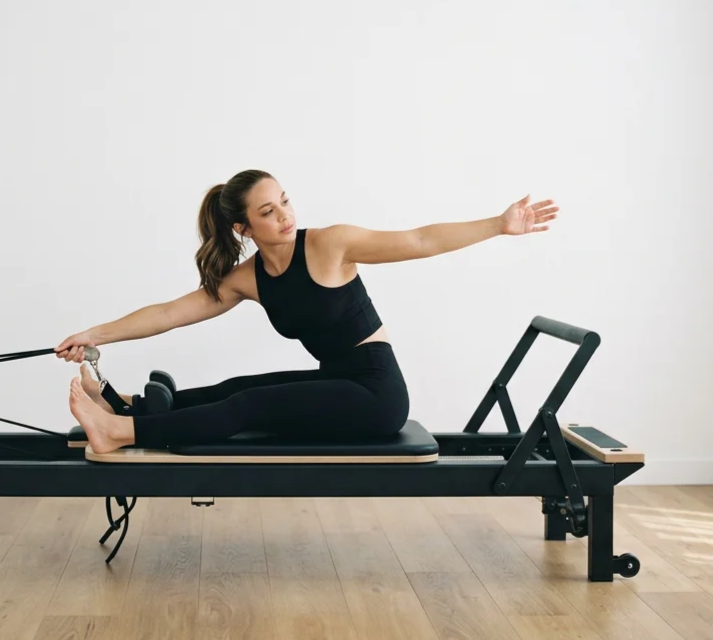
Spine Twist Strap-assisted. Head follows the back hand. Spiral Movement of the spine.
Many training programmes are built mostly around movements in one plane: squats, lunges, deadlifts, push-ups, crunches. They’re excellent exercises, and building strength in them is worth doing. But daily life adds side-bending and rotation: reaching into the back seat of a car, looking over your shoulder while cycling, carrying a bag on one side, turning in bed. A body that only trains forward and back has less practice for everything else.
Rotation is also sometimes treated as dangerous for the spine. Like bending, it’s a normal movement that tissues adapt to when it’s loaded gradually. The goal isn’t to avoid twisting. It’s to build the capacity to do it well, and often.
6 · Pilates had it from the start
Joseph Pilates’ original mat sequence already contained rotation: the saw, spine twist, corkscrew and criss-cross. Across the apparatus, each piece of equipment adds its own version:
Mat: saw and spine twist for thoracic rotation with the pelvis stable; criss-cross for rotation with abdominal load; corkscrew for rotation driven from the pelvis.
Reformer: mermaid with twist; short box twist and reach; kneeling arm work with rotation, where the strap pulls you out of line and you resist it.
Cadillac: push-through with rotation; standing arm springs with a turn, which trains the diagonal from hand to opposite foot.
Wunda Chair: seated twist pressing the pedal, so the arms work while the spine turns over a stable pelvis.
Ladder Barrel: side sit-up with twist, combining side-bending and rotation under the weight of the trunk.
Spine Corrector: corkscrew and hip circles, rotating the pelvis under a supported spine.
7 · Three exercises to train rotation at home
Each of these trains one part of what we covered above: the upper back turning over a stable pelvis, the pelvis turning under a stable ribcage, and the diagonal connection across the back. Do them slowly. Rotation is a control skill before it’s a range-of-motion skill.
1 · Seated thoracic rotation
Targets: Thoracic spine rotation and the obliques, with the pelvis kept still
Why: The upper back is built to rotate; the lower back isn’t (section 2). If the thoracic spine is stiff, the lumbar spine, neck or shoulders make up the difference.
Set-up: Sit on the front edge of a chair, feet flat and hip-width apart, knees pointing forward. Squeeze a cushion or yoga block lightly between your knees: if it slips, your pelvis has moved. Cross your arms, hands on opposite shoulders.
Movement: Inhale and grow tall. Exhale and turn your ribcage to the right, as far as you can without the knees moving. Inhale back to centre. Exhale to the left.
Cues: “Turn the ribcage like the lid of a jar; the pelvis is the jar.” “Get taller as you turn,” so you rotate instead of slumping or leaning. Keep your weight even on both sitting bones.
Watch for: Knees sliding forward or back, leaning back, tipping sideways, shoulders lifting towards the ears.
Dose: 6–8 slow turns per side, about 3 seconds out and 3 back.
Progress: Hold your arms straight in front of you with your palms together. The longer lever makes the obliques work harder.
2 · Standing pelvic rotation at the wall
Targets: Hip rotation (one hip turns in while the other turns out) and control of the pelvis under a still ribcage
Why: This is the counter-rotation you use in every step (section 1). It’s also the pattern that tends to go “stiff” in people with persistent back pain (section 4).
Set-up: Stand facing a wall, hands on it at shoulder height, feet hip-width apart, knees soft.
Movement: Keep your chest and hands quiet. Turn your pelvis so the right hip moves back and the left hip moves forward. Return to centre, then turn the other way. Small range.
Cues: “Your hip bones are headlights: turn them. Your breastbone keeps looking at the wall.” Keep the feet rooted and the weight even on both.
Watch for: Shoulders turning with the pelvis, knees locking, rushing.
Dose: 8–10 slow turns each way.
Progress: Take your hands off the wall and cross your arms. Now the trunk has to stay still on its own.
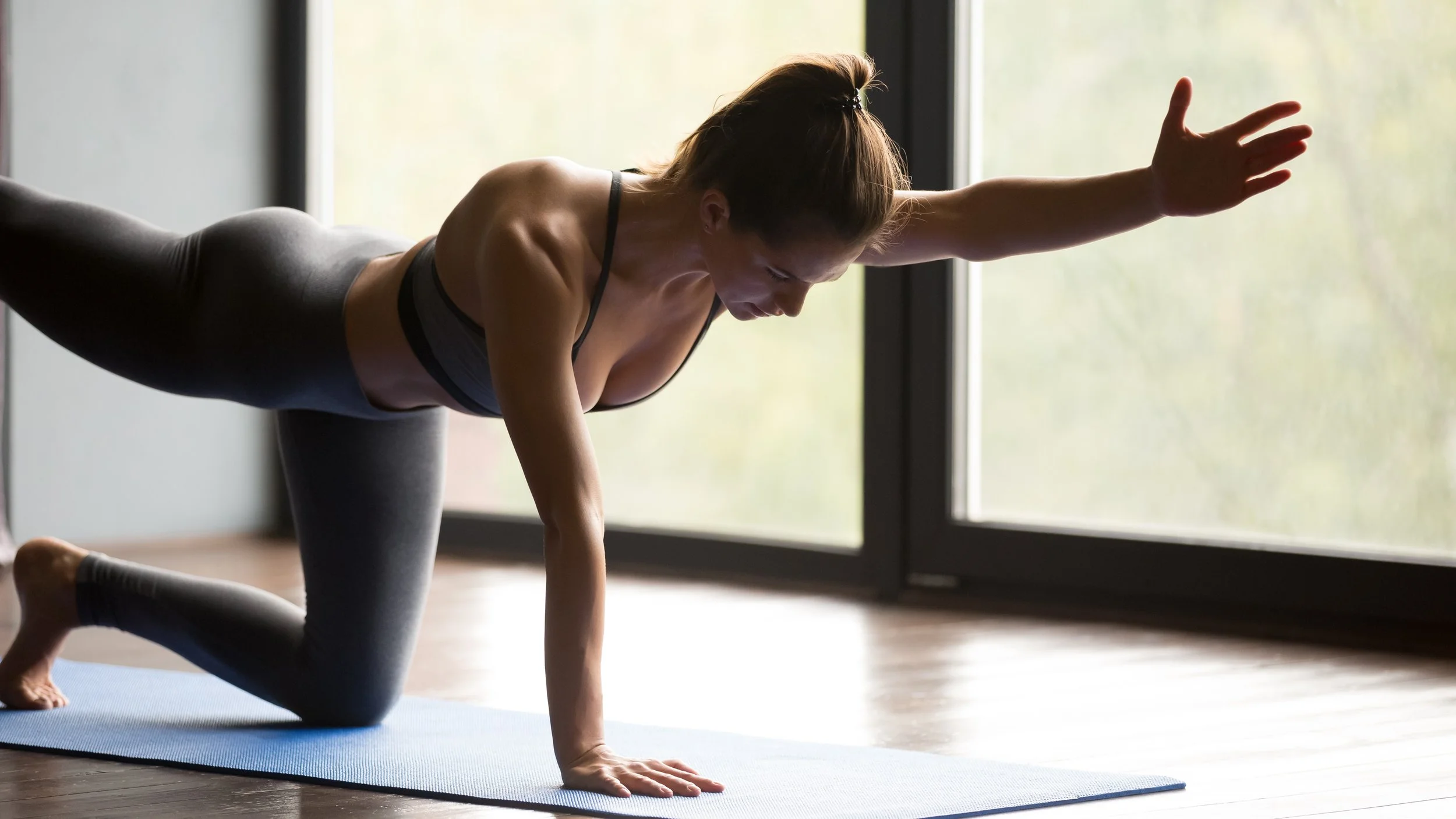
3 · Bird dog with a long diagonal reach
Targets: The back functional line: latissimus dorsi, thoracolumbar fascia and the opposite gluteus maximus, plus the trunk control that stops you rotating
Why: It trains the diagonal from section 3 under load. It also works the back extensors with relatively low compression on the lumbar spine (Callaghan et al., 1998).
Set-up: On all fours, hands under shoulders, knees under hips, spine in your own neutral.
Movement: Exhale and slide your right arm forward and your left leg back along the floor, then lift both to about hip and shoulder height. Reach long in opposite directions for 2–3 breaths. Return and switch.
Cues: “Reach long, not high.” “Push the floor away with the standing hand,” to keep the shoulder blade on the ribs. “Drive the heel back as if you were pushing a door closed.” Imagine a glass of water on your lower back that mustn’t spill.
Watch for: The lifted hip rotating up, the lower back arching, the leg rising above hip height.
Dose: 6–8 per side.
Progress: Between reaches, bring the elbow and opposite knee towards each other under your body, then extend again. That adds rotation and flexion to the diagonal.
Notice which side is harder in each. A difference between sides is normal and isn’t a problem to fix. It just shows you where there’s more to train.
Want to find out which way you turn more easily? Book a session.
Want to find out which way you turn more easily? Book a session.
References1. Collins SH, Adamczyk PG, Kuo AD. Dynamic arm swinging in human walking. Proc R Soc B. 2009;276(1673):3679–3688.2. White AA, Panjabi MM. Clinical Biomechanics of the Spine. 2nd ed. Philadelphia: Lippincott; 1990.3. Vleeming A et al. The posterior layer of the thoracolumbar fascia: its function in load transfer from spine to legs. Spine. 1995;20(7):753–758.4. Wilke J, Krause F, Vogt L, Banzer W. What is evidence-based about myofascial chains: a systematic review. Arch Phys Med Rehabil. 2016;97(3):454–461.5. Lamoth CJ et al. Pelvis-thorax coordination in the transverse plane during walking in persons with nonspecific low back pain. Spine. 2002;27(4):E92–E99.6. Callaghan JP, Gunning JL, McGill SM. The relationship between lumbar spine load and muscle activity during extensor exercises. Phys Ther. 1998;78(1):8–18..