
Ep.3 - Tensegrity: the positive tension that holds you together
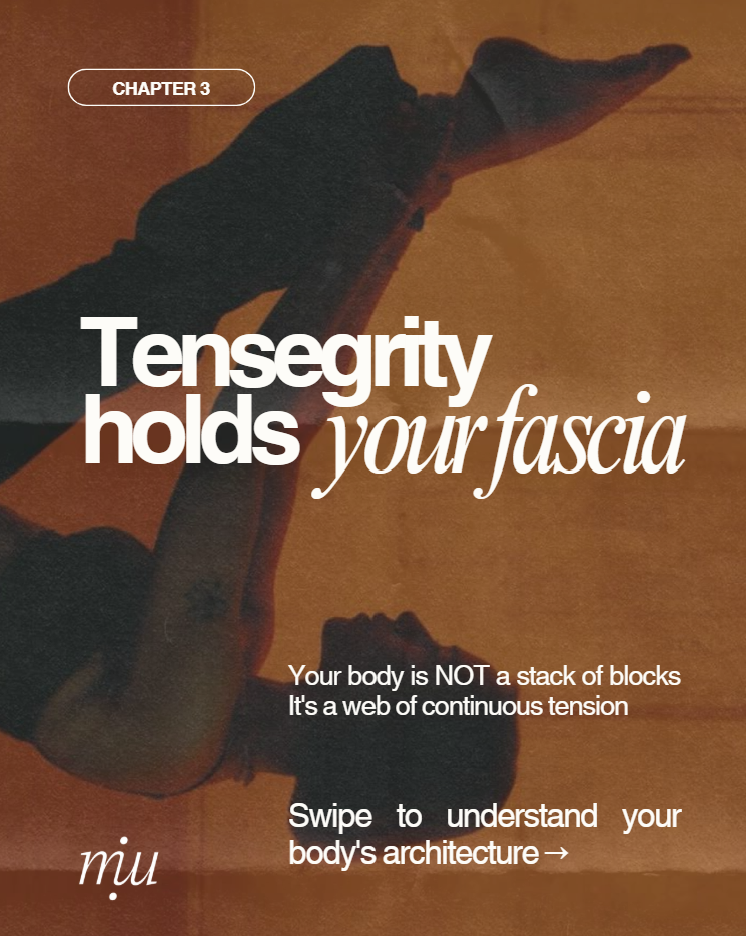
Why does a calf stretch change how your neck turns? Because your body isn't a stack of blocks. It's a web of continuous tension, and that tension is something to train, not get rid of.
This article expands Chapter 3 of the series, made with fasciotherapist and osteopath Gemma Castellano. The carousel gave you the idea. Here is where it comes from, what the research actually supports, where the popular version goes too far, and what it changes in a Pilates session.
1. Tensegrity: stability from tension, not stacking
Tensegrity is a way of building where rigid parts don't rest on each other. They float inside a net of cables that is always under tension, and that tension is what holds the shape.
The idea came from art before it reached anatomy. In 1948 the sculptor Kenneth Snelson, then a student of Buckminster Fuller, built a small structure of wooden struts that touched nothing but wire. Fuller named the principle tensegrity, a contraction of "tensional integrity".
Compare it with a brick wall. A wall stands because each brick presses down on the one below: all compression, all local. Take out a brick at the bottom and the bricks above fall. In a tensegrity, the compression parts are islands, the tension is continuous, and a load anywhere is shared by the whole net.
The tent
A tent is the everyday version. The poles push (compression). The ropes and fabric pull (tension). Neither stands alone: a pole without ropes falls over, ropes without a pole lie on the ground. Tighten one guy rope and the whole tent changes shape, not just the corner you pulled.
That's the picture the carousel used: poles = bones, ropes = fascia.
It's a useful starting point. Section 5 covers where it stops working.
2. From sculpture to body: biotensegrity
In the 1970s and 80s the orthopaedic surgeon Stephen Levin proposed that living bodies are built this way too. He called it biotensegrity: bones act as the struts and the soft tissues around them (fascia, ligaments, tendons, muscle) as the continuous tension network.
His argument started with a question classic mechanics struggled with. A spine modelled as a column of stacked blocks shouldn't survive the loads it handles every day, and a column can't work upside down. Yet you can hang from a bar, do a headstand or a Teaser, and your spine keeps its shape in every orientation. A tension network explains that much better than a stack does.
All the way down to your cells
The cell biologist Donald Ingber found the same principle inside the cell. The cytoskeleton has stiff microtubules that resist compression and fine actin filaments that pull. Change the tension on the outside of a cell and the inside reorganises. That's one route by which cells "feel" mechanical load and respond to it, a process called mechanotransduction.
This matters for training. Load isn't just something tissues survive. It's a signal they read, all the way down to the cell.
So what is fascia?
Fascia is the connective tissue that wraps, separates and links everything: each muscle fibre, each muscle, groups of muscles, organs, bones. It's mostly collagen and elastic fibres in a watery gel, with cells (fibroblasts) that keep remodelling it.
It isn't one sheet you could peel off like a wetsuit. It's many layers with different jobs: some slide over each other, some transmit force, some are packed with sensory nerve endings. What they share is continuity: there is no clean place where one ends and the next begins.
3. Is it really all connected? What the research shows
Partly yes, and more interestingly than "everything is connected". The research shows real connections along specific routes, not everywhere equally.

Force really does travel between muscles. A systematic review by Krause and colleagues (2016) found good evidence that force passes from one muscle to its neighbours through the fascia between them. Muscles aren't sealed units. When one contracts, some of that force reaches the next.
Some "chains" hold up, others don't yet. Wilke and colleagues (2016) checked the myofascial lines popularised by Tom Myers' Anatomy Trains against dissection studies, transition by transition:
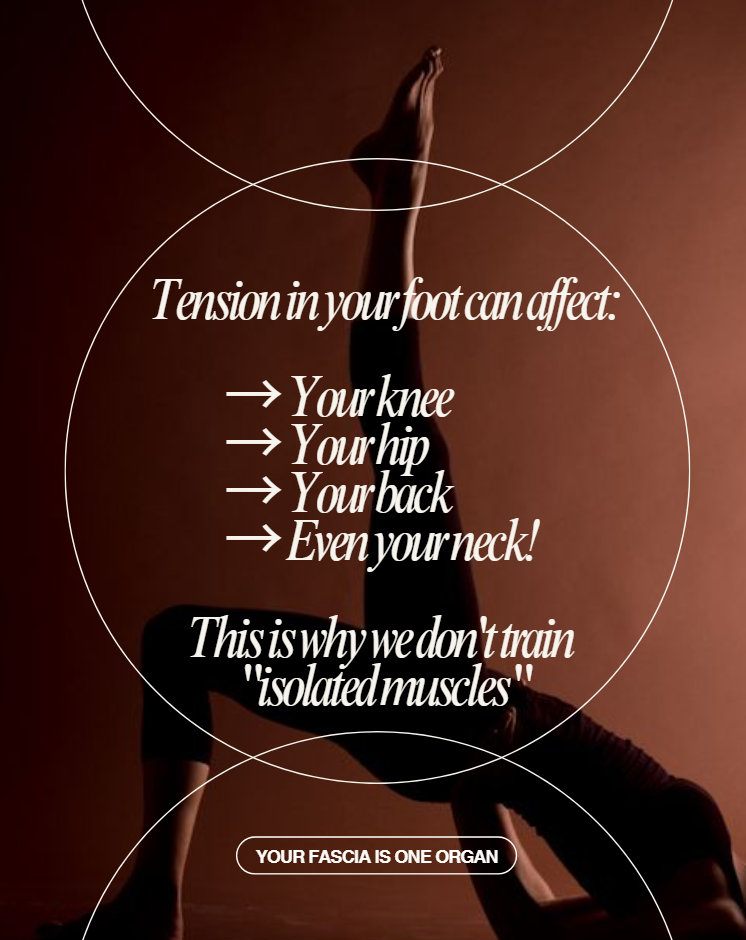
And the foot-to-neck slide? It isn't just a metaphor. In a small study, Wilke and colleagues (2016) had people stretch their calves and hamstrings. Their neck range of motion improved, even though nobody touched the neck. That fits the superficial back line, which runs from the sole of the foot up to the skull.
So the carousel's claim that tension in your foot can affect your knee, hip, back and neck stands. The honest word is can: these are measurable links, not guaranteed causes.
4. Positive tension: why you don't want to "release" everything
Tension has a bad reputation. We say "I'm so tense" as a complaint, and a lot of wellness content promises to melt it away. But a tensegrity structure without tension collapses. You don't need less tension, you need the right tension: enough to hold shape and spring back, not so much that nothing can move.
What healthy tension does, in the carousel's five words and the science behind each:
Responsive to load. Fibroblasts sense mechanical strain and adjust how much collagen they make and how they lay it down. The tissue reorganises along the lines it's loaded.
Stores and releases energy. Tendons and the fascia around them act like springs. Kawakami and colleagues (2002) filmed the calf during a small jump with ultrasound. The muscle fibres barely changed length while the tendon stretched and recoiled, doing much of the work. That's elastic recoil, and it's why bouncing is cheap and stiff landings are expensive.
Elastic and resilient. Collagen fibres in well-loaded fascia have a wavy pattern (crimp) that lets them stretch and return. In tissue that's rarely loaded, the arrangement becomes more random and less springy.
Distributes forces. As section 3 showed, force spreads to neighbouring muscles instead of concentrating in one spot.
Allows fluid movement. Fascial layers need to slide over each other. That gliding depends on movement and on a lubricating substance (hyaluronan) between the layers.
Fascia isn't purely passive
Fascia contains cells called myofibroblasts that can contract slowly, over minutes to hours, not seconds. Schleip and colleagues (2005) proposed that this lets fascia adjust its own stiffness, partly under the influence of the nervous system. It's an active, living tissue, not a passive wrapper.
It changes, slowly
Muscle adapts in weeks. Collagen-rich tissue adapts in months. Training principles for fascia (Schleip & Müller, 2013) suggest thinking in a timeframe of six months to two years for real structural change. That's not a reason to give up. It's a reason to train consistently and not judge the work by one class.
5. What tensegrity doesn't say
Tensegrity is a powerful lens, and it gets oversold. Here's where the popular version goes further than the evidence.
Bones don't literally float. Your knee and hip carry several times your body weight when you walk or climb stairs, through cartilage pressed against cartilage. The body uses compression and continuous tension. Biotensegrity is best read as a model that explains things a stack of blocks can't, not as a literal blueprint.
"One organ" is a debate, not a fact. Fascia is continuous, and many researchers now treat it as one body-wide system. Whether that makes it one organ is a matter of definition. The continuity is the useful part.
A link is not a cause. Tight calves can influence the back, but back pain has many contributors: load, sleep, stress, history, beliefs about pain. Fascia is one of them, not the master key.
Manual work probably doesn't stretch fascia like dough. Chaudhry and colleagues (2008) calculated that permanently deforming dense fascia, like the fascia of the thigh or the sole of the foot, would take forces far beyond what hands can apply. That doesn't mean manual therapy doesn't work. It means it likely works through the nervous system. Fascia is full of sensory receptors, and skilled touch changes tone, perception and how you then move (Schleip, 2003).
Joseph Pilates didn't know the word. Tensegrity was named after he built his method. What we can say is that his method trains the body in ways that fit the model well. That's a stronger claim, because it's one we can defend.
6. How Pilates trains positive tension
If the body is a tension network, it makes sense to train the network, not just the muscles one by one. Five principles shape how we work at Moow.
Whole-body integration over isolation. Most Pilates exercises ask the whole chain to organise around one movement. In a Teaser or a Long Stretch, feet, legs, trunk and arms are part of one shape, not separate jobs.
Load in many directions. Fascia adapts along the lines it's loaded. Flexion, extension, side bending and rotation each load different routes:
Swan and Long Stretch load the front of the body.
Footwork, Short Spine and Elephant load the back line from the sole of the foot up.
Mermaid and side-lying work load the sides.
Saw, Spine Twist and Corkscrew load the spirals.
Lengthen under load. The springs on the reformer make the return phase of almost every exercise an eccentric one: you lengthen while resisting. That's one of the most effective stimuli for collagen-rich tissue, and very different from passive stretching.
Train the spring. Positive tension isn't only slow. Heel bounces in Footwork, the Jumpboard and small rebounding movements train the elastic recoil from section 4. (More on that in our article on variability.)
Precision and attention. Because fascia is so rich in sensory receptors, how you move counts as well as how much. Moving with attention refines the map your nervous system keeps of your body, and that map shapes your tension.

Hands and movement: working with Gemma
This series is a collaboration with Gemma Castellano, fasciotherapist and osteopath. Our roles complement each other.
Gemma works hands-on. She finds where tissue is sensitive, guarded or not sliding well, and uses touch to change how it behaves and how it feels.
I work with movement. Once there's a new option, Pilates gives the body a reason to keep it: load, repetition and variety, week after week, for the months fascia needs to remodel.
Manual therapy opens a door. Movement is what walks through it.
